

What Is GEO? Generative Engine Optimization Explained (2026 Guide)
 Catalin Dinca
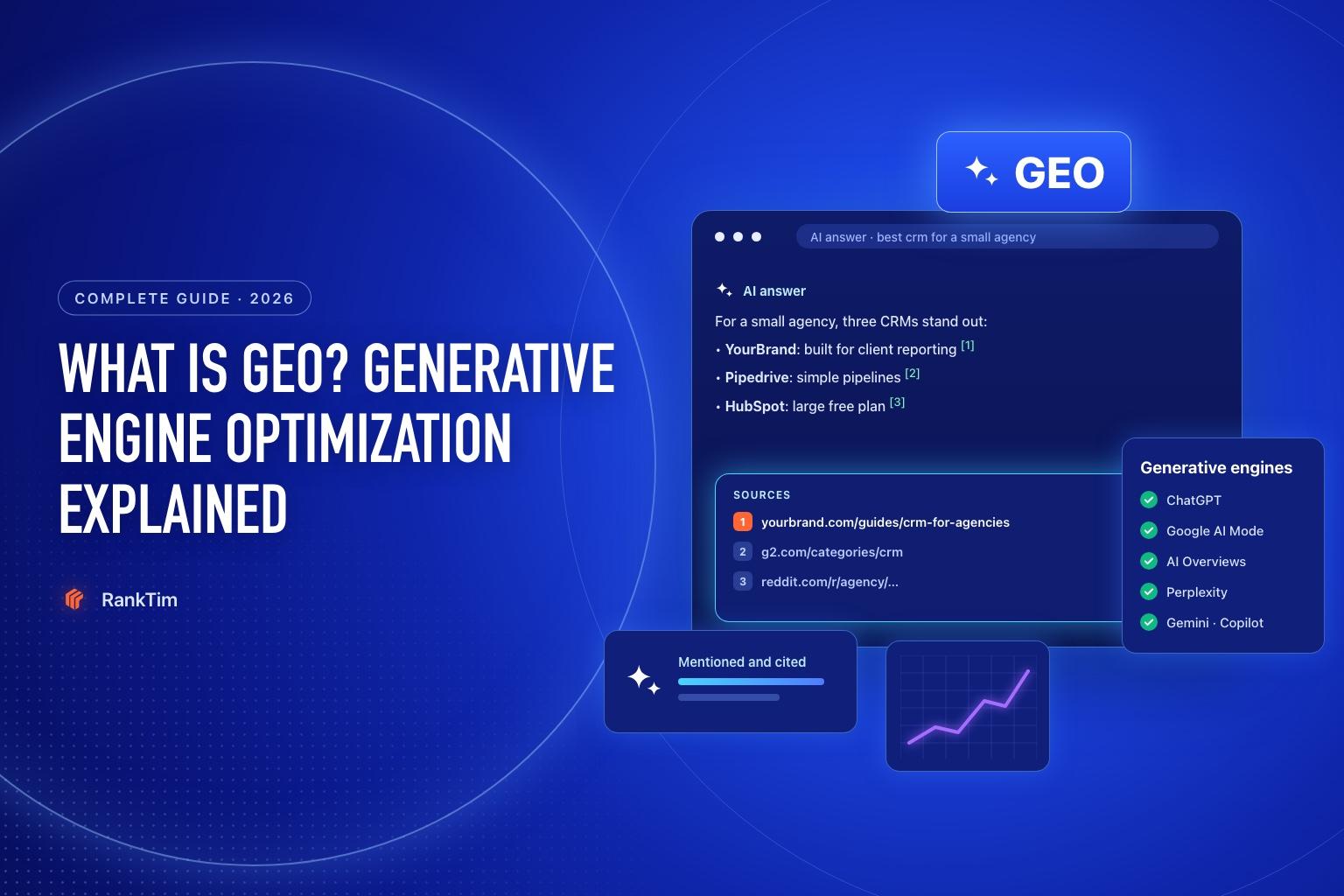
Generative engine optimization (GEO) is the practice of making your brand and content easy for AI assistants to find, understand, trust and cite, so that when people ask ChatGPT, Google AI Mode, AI Overviews, Gemini, Perplexity or Copilot a question in your market, your brand is part of the answer.
Search behavior has changed fast. Google said in 2026 that AI Overviews reach more than 2.5 billion people a month and AI Mode more than 1 billion, and OpenAI reported more than 800 million weekly ChatGPT users back in late 2025. A growing share of buying journeys now start with a question to an AI assistant, not a list of blue links.
This guide covers everything you need to get started: what GEO is, how it compares to SEO and AEO, how generative engines choose their sources, the five-step GEO framework and a checklist you can apply this week.
What Does GEO Mean?
The term comes from a research paper, "GEO: Generative Engine Optimization", first published in November 2023 by researchers from Princeton and other institutions and presented at the KDD 2024 conference. The authors defined generative engines as systems that search for information and then generate an answer with a language model, citing sources along the way.
They tested several ways to improve how visible a source is inside those answers, such as adding statistics, quotations and citations to credible sources. Their conclusion: the right changes can increase visibility in generative engine responses by up to 40%, with results varying by domain.
In practice, GEO today covers three outcomes:
- Mentions: the AI names your brand in its answer, ideally as a recommendation.
- Citations: the AI links to your page as one of its sources.
- Accurate descriptions: the AI describes your product, pricing and strengths correctly.
GEO vs SEO vs AEO
GEO doesn't replace SEO. It builds on it. Most generative engines retrieve their sources from a search index, so a page that can't be found in search rarely makes it into an AI answer.
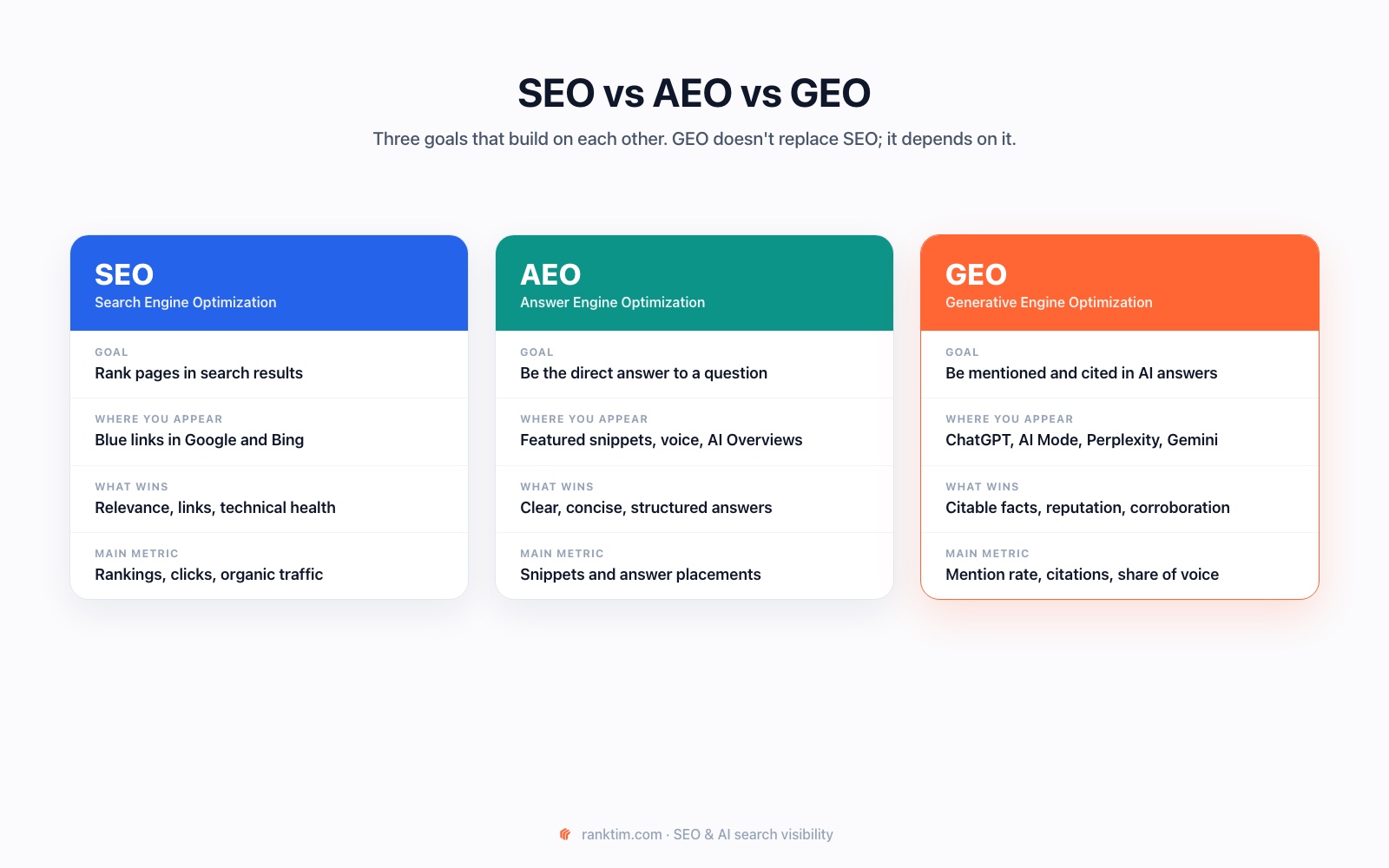
| SEO | AEO | GEO | |
|---|---|---|---|
| Goal | Rank pages in search results | Be the direct answer to a question | Be mentioned and cited in AI-generated answers |
| Where | Google and Bing results | Featured snippets, voice assistants, AI Overviews | ChatGPT, AI Mode, AI Overviews, Gemini, Perplexity, Copilot |
| Unit that competes | The page | The answer block | The passage, and the brand behind it |
| Key signals | Relevance, links, technical health | Clear, concise, structured answers | Citable facts, reputation, mentions across the web |
| Main metrics | Rankings, clicks, traffic | Snippets won | Mention rate, citations, share of voice, sentiment |
The simplest way to see it: SEO gets you considered, AEO makes you quotable and GEO makes you the brand the AI chooses to recommend.
How Generative Engines Choose Sources
Each assistant works a little differently, but most follow the same pattern:
- They interpret the prompt and often split it into several related searches. Google calls this query fan-out.
- They retrieve candidate pages from a search index. For Google's AI features, a page must be indexed and eligible to show a snippet; Google says there are no additional requirements.
- They pick the best passages: relevant, clear, specific and from sources that look trustworthy.
- They synthesize an answer and link to some of the sources they used.
- They also rely on what they already know. Models learn from the open web, so how your brand is described on review sites, in the press and in communities shapes answers even when no link is shown.
That last point is why GEO is more than on-page optimization. You need to be both the best source to cite and a brand that's widely and consistently described.
The GEO Framework in 5 Steps
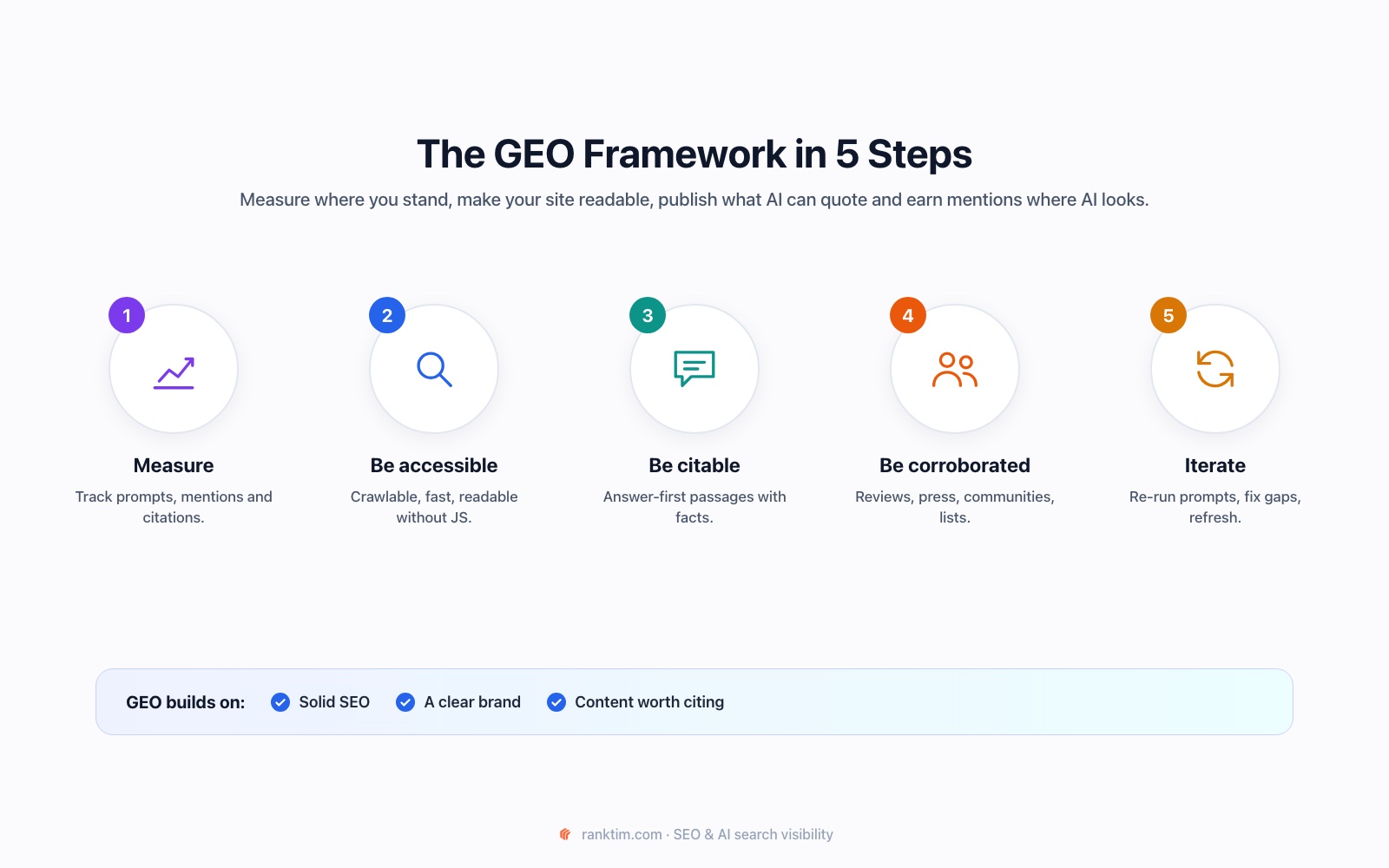
1. Measure Where You Stand
You can't improve what you don't measure, and AI visibility isn't visible in Search Console. Build a list of 20 to 50 prompts your customers ask, from "best [category] for [audience]" to "[competitor] alternatives". Our prompt research tutorial shows where to find them.
Then track them across assistants. The core GEO metrics are:
- AI visibility (mention rate): the share of answers that mention your brand.
- Share of voice: your mentions compared with competitors'.
- Ranking: where you appear when several brands are listed.
- Sentiment: whether the AI describes you positively, neutrally or negatively.
- Cited pages: which URLs, yours and others', the AI uses as sources.
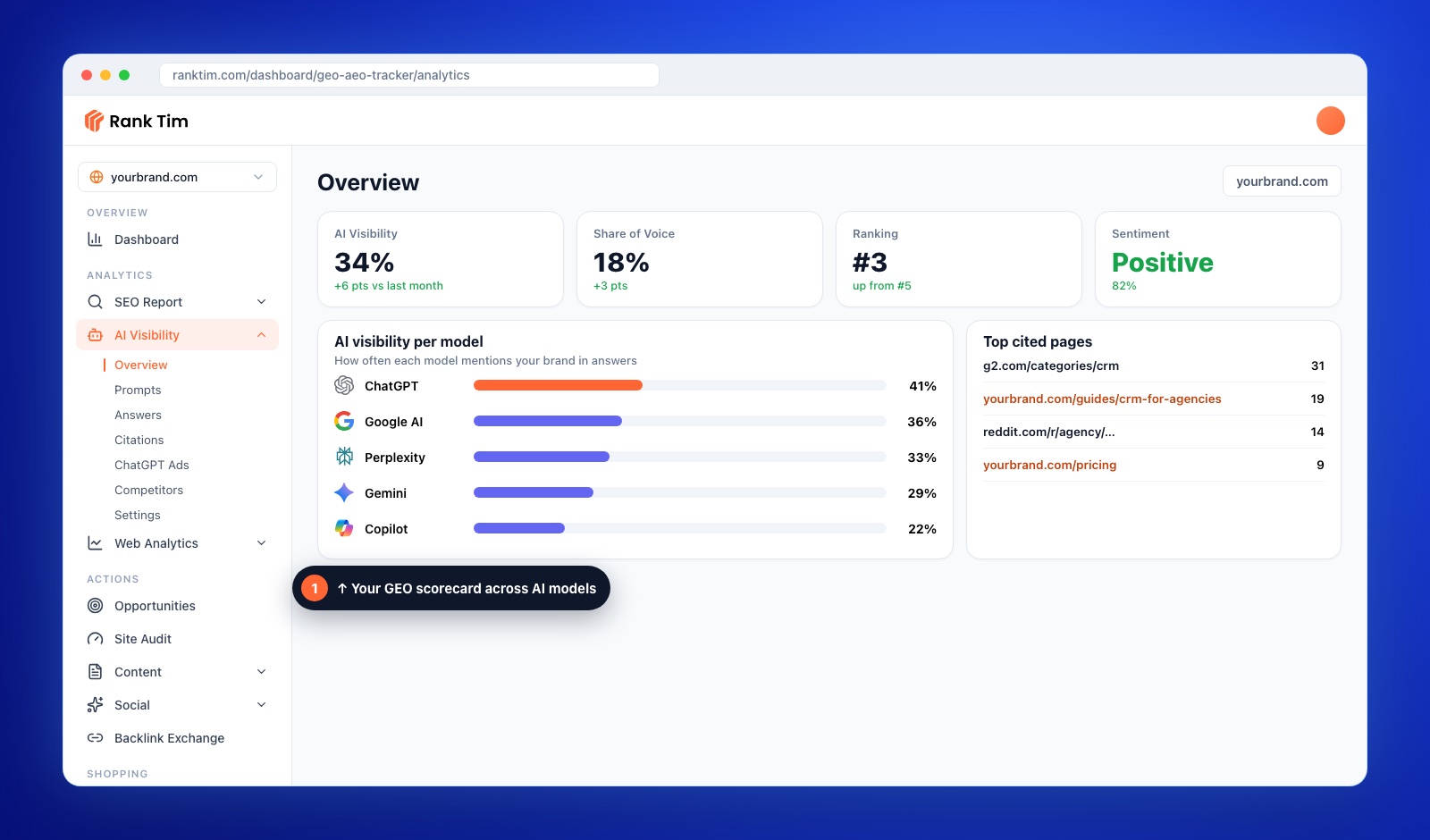
In RankTim, AI Visibility → Overview brings these metrics together per model, so you can see, for example, that ChatGPT mentions you often while Copilot rarely does. Our step-by-step tracking tutorial covers the full setup.
2. Make Your Site Accessible to AI
If AI crawlers can't read your pages, nothing else matters:
- Allow the AI crawlers you want, such as OAI-SearchBot, GPTBot, PerplexityBot and ClaudeBot, in robots.txt and in your firewall or CDN.
- Make sure important content is in the HTML, not only rendered by JavaScript.
- Keep pages fast, indexable and eligible for snippets.
Our guide on how to optimize your website for AI search walks through each check.
3. Make Your Content Citable
AI assistants quote passages, not pages. Write sections that can stand on their own:
- Answer first: the direct answer in the first one or two sentences under each heading.
- Be specific: numbers, prices, dates, named products and clear conditions.
- Structure for extraction: question-style headings, short paragraphs, lists and tables.
- Add proof: statistics, quotations and links to credible sources, the same tactics the GEO paper found most effective.
- Mark it up: structured data that matches the content. See our schema markup guide.
4. Earn Corroboration Across the Web
AI systems trust what many independent sources agree on. Work on the places they cite in your category:
- reviews on the platforms that appear in AI answers
- listicles and comparison articles: our citation outreach tutorial shows how to get included
- communities like Reddit, done honestly: see our community guide
- original research others quote: see how to create research AI cites
Keep your brand name, description and key facts consistent everywhere. Contradictions are one of the main reasons AI describes brands incorrectly. If that's already happening, follow our guide on how to fix what AI says about your brand.
Get your GEO baseline in minutes
RankTim runs your prompts across ChatGPT, Google AI Mode, Gemini, Perplexity and Copilot and shows your AI visibility, share of voice, sentiment and the pages AI cites, next to your classic SEO data.
Start Your Free Trial5. Iterate
AI answers change as models, indexes and sources change. Re-run your prompts every one to four weeks and look for:
- prompts where competitors are mentioned and you aren't
- sources cited often in your category where your brand is missing
- pages of yours that rank in Google but are never cited, then analyze them one by one with a page-level citation analysis
- cited pages with outdated facts, which need a content refresh
The GEO Checklist for 2026
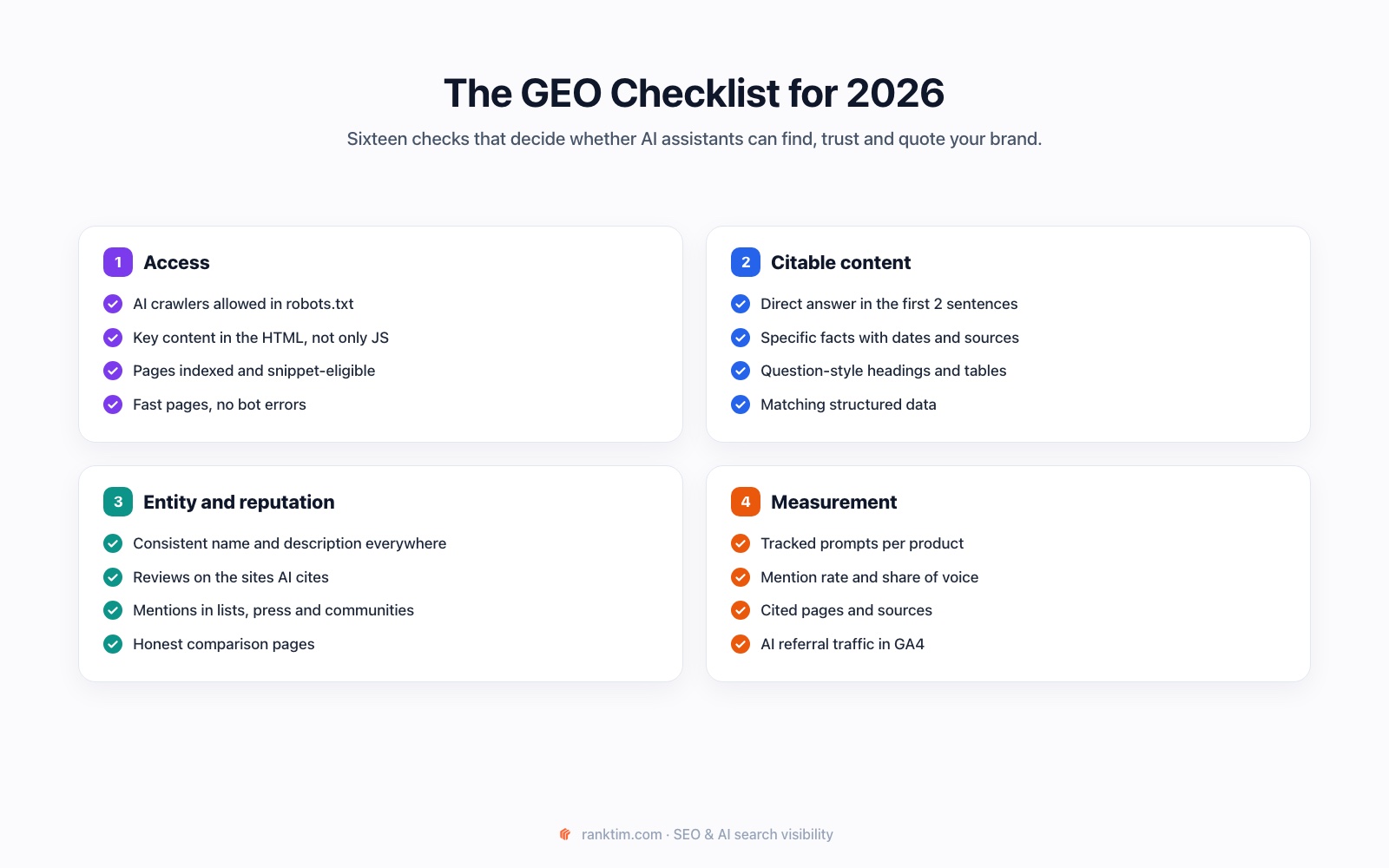
- Access: AI crawlers allowed, key content in HTML, pages indexed and snippet-eligible, no bot errors.
- Citable content: direct answers first, specific facts with dates and sources, question headings and tables, matching structured data.
- Entity and reputation: consistent brand information, reviews where AI looks, mentions in lists, press and communities, honest comparison pages.
- Measurement: tracked prompts per product, mention rate and share of voice, cited pages and sources, and AI referral traffic in GA4. Our GA4 guide shows how to set it up.
Common GEO Myths
- "GEO replaces SEO." No. Most AI answers are built on search results. Weak SEO usually means weak GEO.
- "You need special markup or an llms.txt file to appear in AI answers." Google says no special markup is needed for its AI features. Structured data and llms.txt can help some systems understand your site, but they're not a ticket into answers.
- "You can buy your way into AI answers." ChatGPT now shows ads, but OpenAI says they're separate from the answer and don't influence it. See what ChatGPT ads mean for organic visibility.
- "Clicks are the only metric that matters." Many AI answers are read without a click. Mentions and accurate descriptions shape decisions even in zero-click searches.
FAQ
What is generative engine optimization in simple terms?
GEO is the work of making AI assistants mention, recommend and cite your brand when people ask questions in your market. It combines good SEO, content that's easy to quote and a strong reputation across the web.
Is GEO the same as AI SEO or LLM SEO?
Mostly, yes. "AI SEO", "LLM SEO" and "AI search optimization" describe the same goal. GEO is the term from the original research and is now the most widely used.
How long does GEO take to show results?
Assistants that search the web live can pick up new or updated pages within days or weeks. Changing how AI describes your brand overall usually takes two to six months of consistent work.
How do I measure GEO?
Track a fixed set of prompts across AI assistants and measure mention rate, share of voice, sentiment and citations over time, plus AI referral traffic in your analytics.
Can small businesses compete in GEO?
Yes. AI assistants cite the best passage for each part of a question, not just the biggest brand. Specific, honest, well-structured content from a small business can be cited next to much larger competitors.
GEO is not a trick or a replacement for SEO. It's the next layer: being the source AI trusts and the brand it recommends. Measure where you stand, fix access, make your content citable, earn mentions where AI looks and keep iterating.
Start Doing GEO With Real Data
Track how AI assistants mention and cite your brand, find the sources and prompts where competitors win and turn the gaps into content, all in one place.
Start for Free
Catalin Dinca
Written by Catalin Dinca