

Query Fan-Out: How AI Search Breaks Down Questions and How to Optimize for It
 Catalin Dinca
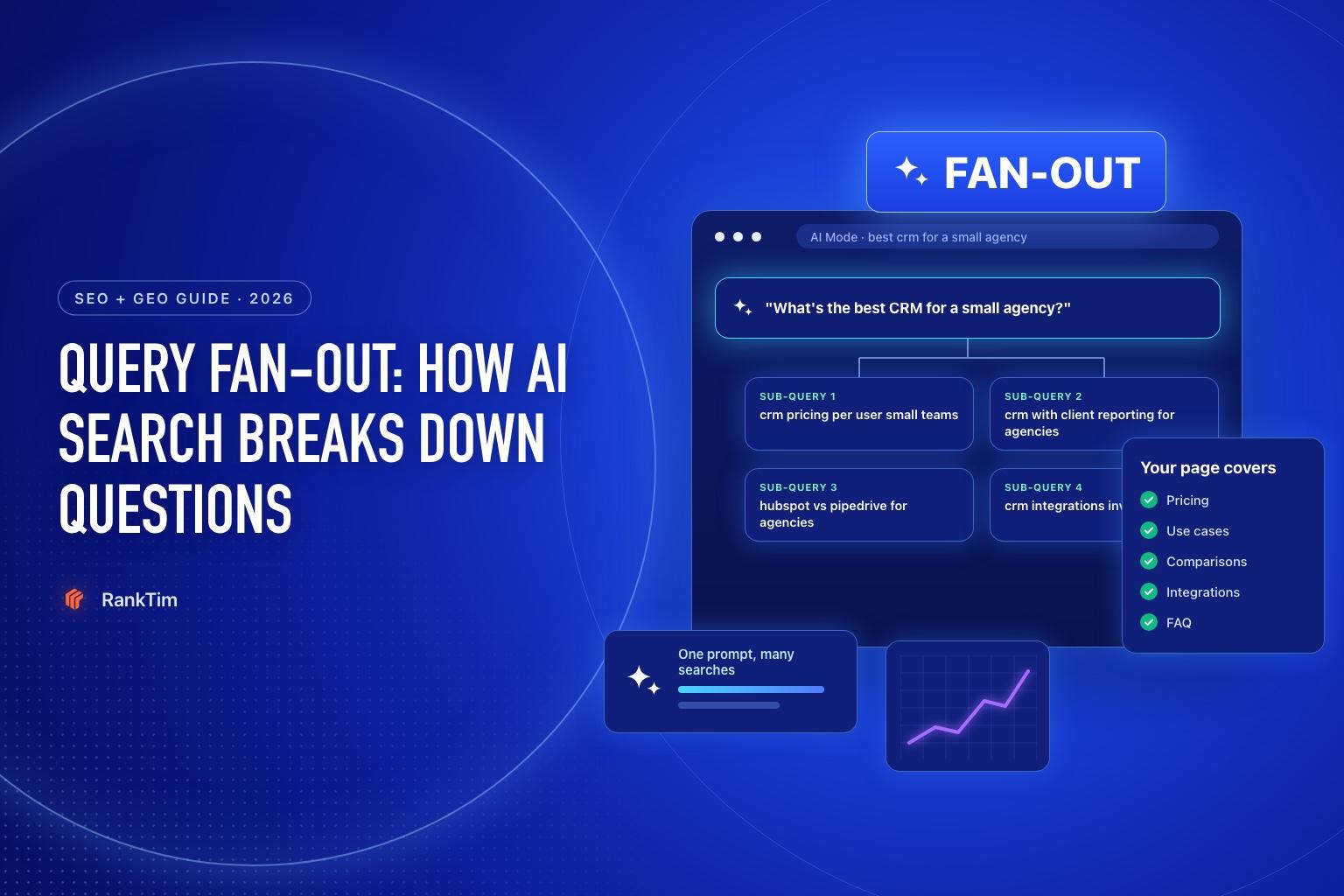
Type "best CRM for a small agency" into Google and you get a list of results for that query. Ask Google AI Mode "what's the best CRM for a five-person marketing agency that also needs client reporting?" and something different happens behind the scenes: the system breaks your question into several smaller searches, runs them at the same time and combines what it finds into one answer.
Google calls this query fan-out. It's one of the most important ideas in AI search right now, because it changes what you're competing for. You're no longer trying to rank for one keyword. You're trying to be the best source for each of the sub-questions hidden inside a prompt.
This guide explains how query fan-out works and how to optimize your content for it, with a practical method you can apply this week.
Time needed: about two hours for your first topic, then 30 to 60 minutes for each new one.
What Is Query Fan-Out?
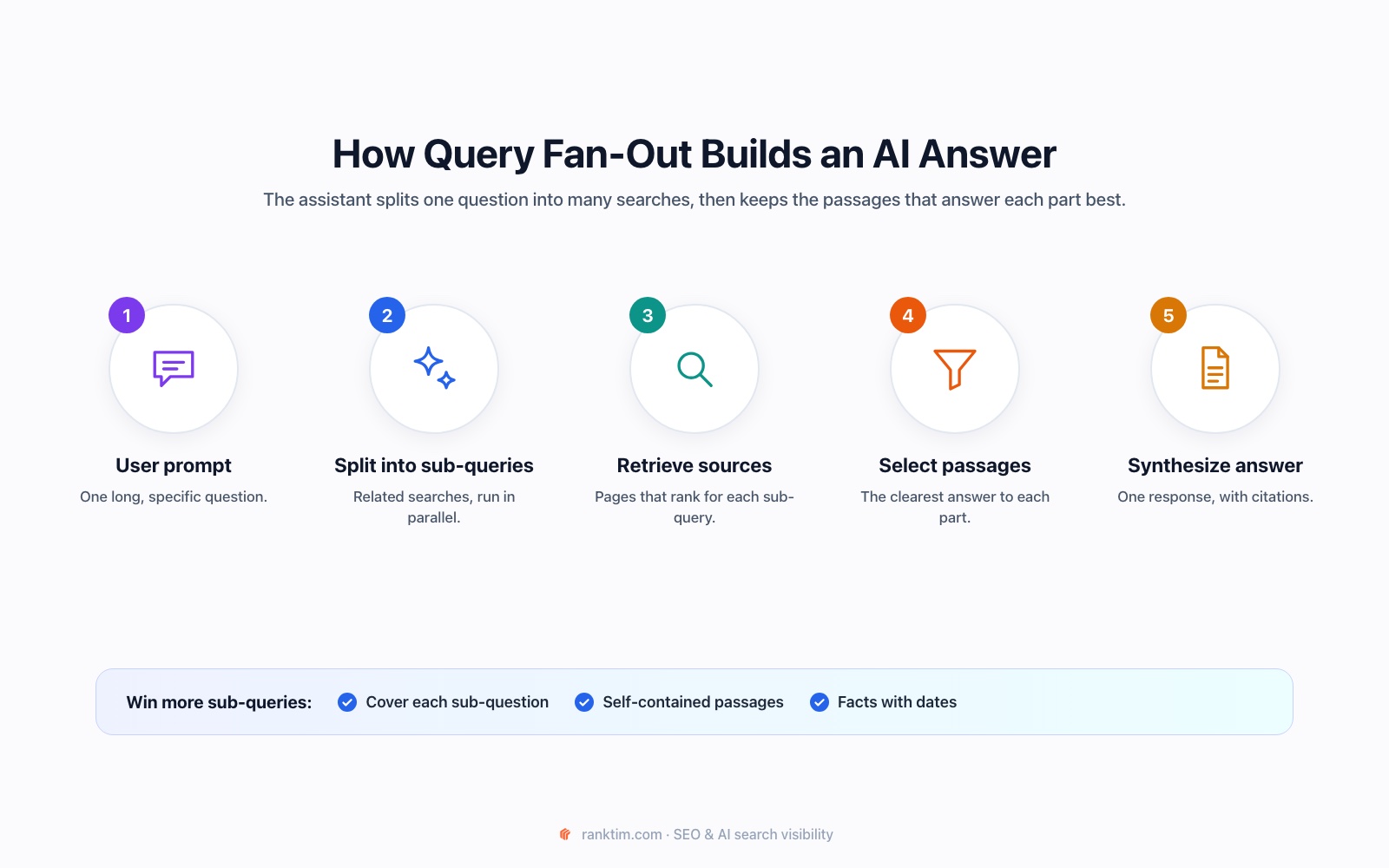
Query fan-out is a technique where an AI search system uses a language model to split one question into multiple related queries, runs those searches in parallel and then synthesizes the results into a single response.
Google introduced the term with AI Mode in 2025. Robby Stein, VP of Product for Google Search, has described it as the model using Google Search as a tool: it decides which searches it needs, issues them and reads the results. Google's own example is a question like "how to fix a lawn full of weeds", which fans out into sub-queries about weed types, herbicide options and prevention. Deep Search takes the same idea further and can run many more searches for a single report. Simple factual questions usually don't need a fan-out at all.
Other AI assistants that search the web, such as ChatGPT and Perplexity, work in a similar way: they rewrite a conversational prompt into one or more search queries before choosing which sources to read and cite.
| Classic search | AI search with fan-out | |
|---|---|---|
| Input | A short keyword | A long, specific, conversational prompt |
| Searches run | One | Several, often many, in parallel |
| What competes | Whole pages | Passages that answer each sub-question |
| Result | A ranked list of links | One answer with a few cited sources |
Why Query Fan-Out Matters for SEO and GEO
- You can rank for the main keyword and still be left out. If your page doesn't answer the sub-question the AI is looking at, it uses another source for that part.
- Smaller sites get more chances. A focused page that answers one sub-question best can be cited next to much bigger brands.
- Coverage beats repetition. Repeating the main keyword doesn't help. Covering the questions around it does.
- Passages matter more than pages. AI systems quote specific sections, so each one needs to stand on its own.
- You can't see the sub-queries. Search Console doesn't show which fan-out searches were run, so you need to anticipate them.
Step 1: Start From Real Prompts
Fan-out begins with the prompt, so start with the questions your customers actually ask AI, not with a keyword list. Collect 10 to 20 core prompts for your most important product or service. Our prompt research tutorial shows where to find them: sales calls, support tickets, Search Console, People Also Ask and the AI assistants themselves.
Good core prompts are specific: "What's the best CRM for a small marketing agency?" is better than "CRM".
Step 2: Expand Each Prompt by Persona
The same need sounds different depending on who's asking. A founder cares about price and value, an account manager about client reporting, an operations lead about integrations. Each of them sends a different prompt, and each prompt fans out differently.
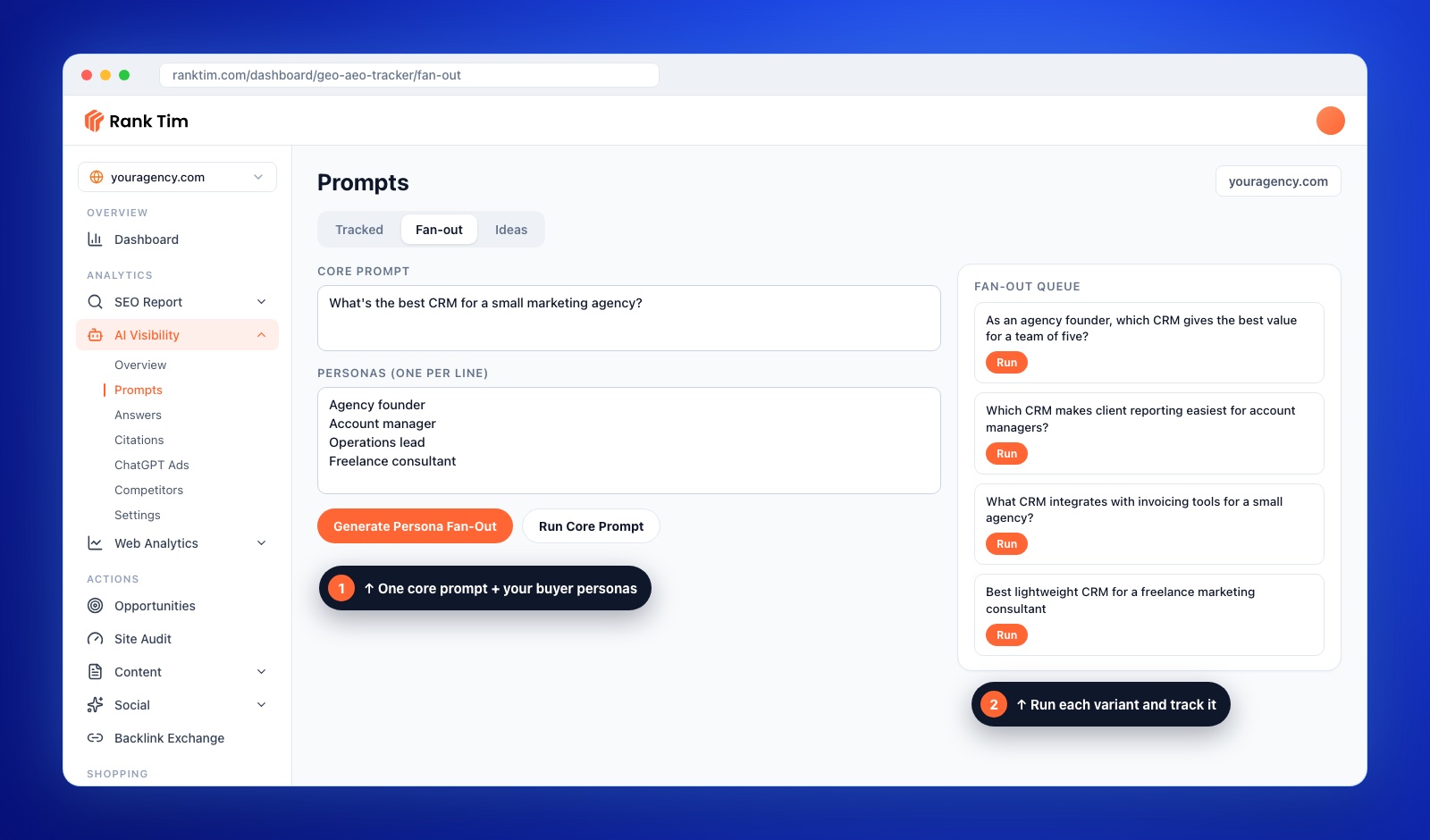
In RankTim, open AI Visibility → Prompts → Fan-out:
- Enter your core prompt.
- Add your personas, one per line, for example "Agency founder", "Account manager", "Operations lead".
- Click Generate Persona Fan-Out. RankTim writes the variations each persona would likely ask.
- Click Run on any variation to see how ChatGPT, Gemini, Perplexity, Google AI and Copilot answer it, and whether your brand appears.
Step 3: Map the Likely Sub-Questions
Next, list the sub-questions an AI system would need to answer each prompt well. Most fall into a few predictable groups:
| Facet | Example sub-question |
|---|---|
| Price | How much does a CRM cost per user for a small team? |
| Fit and use case | Which CRMs are built for agencies and client work? |
| Comparison | HubSpot vs Pipedrive for a small agency |
| Features | Which CRMs include client reporting? |
| Integrations | Which CRMs connect to invoicing tools? |
| Problems and risks | What are the downsides of an all-in-one CRM? |
Validate the list with what you can observe:
- the sources AI assistants cite for your prompts, and the sections of those pages they quote
- People Also Ask questions and Google autocomplete suggestions
- the follow-up questions assistants suggest at the end of an answer
For a deeper method, see our guide to building a long-tail AI visibility keyword map.
Step 4: Decide Which Page Answers Each Sub-Question
Don't create a new page for every variation. Google has explicitly warned against making pages for every query variation to game rankings or AI responses. Instead, decide where each sub-question belongs:
- On the main page: sub-questions that every reader needs, like price ranges and who the product is for.
- On a supporting page: sub-questions that deserve depth, like a comparison or an integration guide.
- In an FAQ section: short, factual sub-questions with a one-paragraph answer.
Link these pages to each other so both readers and search engines see them as one topic. Our topic clusters and internal linking tutorial shows how.
Step 5: Write Passages That Can Win on Their Own
When an AI system picks a source for one sub-question, it usually quotes a short section, not the whole page. Write each section so it works without the rest:
- Use the sub-question as the heading, or something close to it.
- Answer in the first one or two sentences, then add detail.
- Name things explicitly. Write "Pipedrive's Essential plan" instead of "this plan".
- Add specifics: numbers, dates, ranges, conditions and examples.
- Use tables and lists for comparisons, steps and criteria.
Turn one prompt into the questions your buyers really ask
RankTim's Persona Fan-Out takes a core prompt and your buyer personas and generates the variations each of them would ask. Run them across ChatGPT, Gemini, Perplexity, Google AI and Copilot and see where you're missing.
Start Your Free TrialStep 6: Strengthen the Signals Around Each Passage
A good passage still has to be found and trusted:
- Rank organically. Fan-out searches run on the search index, so classic SEO still decides whether you're even considered.
- Keep facts fresh. Show the date and update prices, features and statistics regularly.
- Add structured data that matches the content, such as FAQ, Product or Article markup. See our schema markup guide.
- Get corroborated. Being mentioned on review sites, in communities and in articles AI already cites makes you a safer source to quote.
Step 7: Measure Coverage, Not Just Rankings
Track your core prompts and the persona variations together, and look at three things:
- Mention rate per persona: are you recommended to founders but not to operations leads? That points to a missing sub-topic.
- Cited pages: which of your pages are used as sources, and for which prompts.
- Competitor sources: which pages win the sub-questions you're losing, and what they cover that you don't.
Re-run the prompts every two to four weeks after updating content. Our guide on tracking brand visibility in ChatGPT, Gemini and Perplexity covers the full setup.
Common Mistakes to Avoid
- Creating thin pages for every variation. It adds noise and goes against Google's guidance.
- Writing for the keyword instead of the question. Fan-out rewards answers, not keyword density.
- Burying the answer. If the key fact is in the fifth paragraph, another source will be quoted instead.
- Ignoring personas. One prompt rarely represents everyone who buys from you.
- Expecting to see the sub-queries in Search Console. You won't. Model them from prompts and cited sources instead.
FAQ
Is query fan-out only used by Google?
Google named and described it for AI Mode, and it's also used in Deep Search and some AI Overviews. Other assistants that search the web, like ChatGPT and Perplexity, also turn a prompt into one or more searches before choosing sources.
Can I see which fan-out queries were used for my pages?
Not directly. Google doesn't report fan-out queries in Search Console. You can approximate them by mapping sub-questions, watching which sources AI cites and running persona variations of your prompts.
Should I create a separate page for each sub-query?
No. Cover sub-questions on the pages where they naturally belong, and create a new page only when a sub-question deserves real depth. Google warns against pages made for every query variation.
Does query fan-out replace keyword research?
It extends it. Keywords still show demand and search engines still decide which pages are considered. Fan-out adds a layer on top: the related questions a complete answer needs.
How many personas should I use?
Start with three to five that match your real buyers. More personas create more variations, but only the ones tied to real sales conversations are worth tracking long term.
Query fan-out turns every detailed prompt into a set of smaller questions, and each one is a chance to be cited. Start from real prompts, expand them by persona, cover the sub-questions on the right pages and write passages that can stand on their own. That's how you win the questions behind the question.
Win the Questions Behind the Question
Expand your prompts by persona, track every variation across AI assistants and find the sub-questions where competitors get cited instead of you.
Start for Free
Catalin Dinca
Written by Catalin Dinca