

How to Build a Long-Tail AI Visibility Keyword Map from Customer Questions
 Catalin Dinca
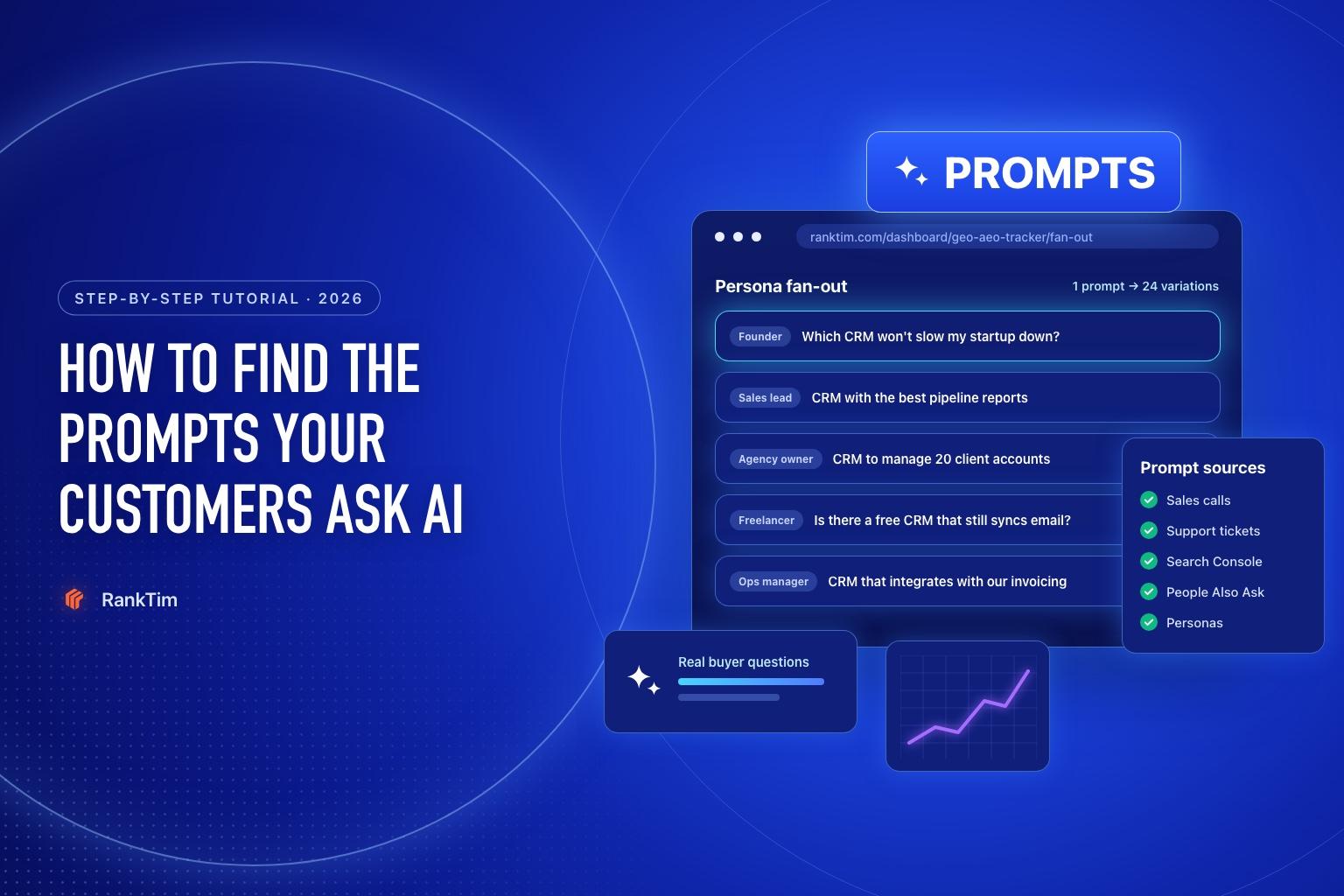
Most keyword research starts with a short phrase: CRM, SEO agency, project management software or AI visibility tool. Those phrases are useful, but they do not sound like the questions a buyer actually asks when the decision becomes specific.
The useful question is usually longer: “What is the best CRM for a five-person agency that needs client reporting?” or “How do I track whether ChatGPT recommends my local business?” Those detailed questions are easier to match with a focused page, easier for an AI system to understand and often much closer to a real decision.
This guide shows how to build a long-tail AI visibility keyword map from customer questions. You will collect the language your buyers already use, expand it into realistic prompt variations, cluster the questions by intent and assign each cluster to the right page. The same map can drive SEO content, AI visibility tracking and your next-quarter editorial calendar.
Time needed: 60–90 minutes for the first map, then 15 minutes a week to keep it current.
What a Long-Tail AI Visibility Keyword Map Is
A normal keyword list is a collection of phrases. A keyword map is a decision system: it connects a question to an audience, an intent, a page and a measurement plan.
For AI search, the map needs one extra layer. You are not only asking whether a page can rank for a phrase. You are asking whether the page gives an assistant a clear, quotable answer when a buyer asks a complete question.
| Map field | What it captures |
|---|---|
| Customer question | The natural-language question a buyer might ask |
| Long-tail variation | The specific context: industry, audience, location, budget or use case |
| Intent | The job behind the question: learn, compare, evaluate or buy |
| Recommended page | The one URL that should answer the question best |
| Evidence needed | Data, examples, pricing, reviews, screenshots or expert guidance |
| AI prompt | The version you will monitor across AI models |
| Success signal | Ranking, click, mention, citation or conversion |
The goal is not to create hundreds of near-duplicate pages. The goal is to reveal the few meaningful question patterns that your broad keyword hides.
Step 1: Start with Customer Language, Not a Keyword Tool
Open a blank sheet and create four columns: exact customer wording, where you found it, who asked it and what they were trying to decide.
Collect at least 20 questions from sources that contain real context:
- Sales call notes and demo questions
- Support tickets and onboarding conversations
- Live-chat transcripts
- Search Console queries that contain question words
- Internal site-search terms
- Product reviews and competitor reviews
- Reddit, forums and industry communities
- The questions your support or sales team repeats every week
Do not clean the language yet. “Can this connect to HubSpot without a developer?” is more useful than a polished phrase such as “HubSpot CRM integration”. The first version carries the constraints that make the answer valuable.
Step 2: Turn Each Question into Long-Tail Variations
Take one real question and expand it across the dimensions that change the answer. The most reliable dimensions are audience, industry, job to be done, constraint, location, stage and comparison set.
For example, start with: “How do I track my brand in AI search?”
| Expansion dimension | Long-tail variation |
|---|---|
| Audience | How does a marketing agency track client brand visibility in AI search? |
| Industry | How does a SaaS company track brand mentions in ChatGPT? |
| Job to be done | How do I find which pages ChatGPT cites about my company? |
| Constraint | How can a small business track AI visibility without checking every model manually? |
| Location | How do I track brand visibility in ChatGPT for a local business? |
| Stage | What should I measure before launching an AI visibility campaign? |
| Comparison | What is the difference between AI visibility tracking and LLM traffic tracking? |
These are not seven pages automatically. They are seven hypotheses. Some belong on one comprehensive guide; others deserve a separate article because the audience, evidence and action are different.
The test is simple: would the answer materially change if the added context changed? If yes, keep the variation. If no, merge it with the parent question.
Step 3: Separate Search Keywords from AI Prompts
A keyword is often two to five words. An AI prompt usually carries a full task and context. Your map should keep both versions because they serve different measurement jobs.
| Search keyword | AI prompt version |
|---|---|
| long-tail keyword research | How do I find long-tail keywords from customer questions for a B2B SaaS website? |
| AI visibility tracking | What is the best way for a small business to track brand visibility in ChatGPT and Perplexity? |
| SEO content brief | What should an SEO content brief include for a page targeting a high-intent comparison question? |
The search keyword helps you plan the page title, URL and internal links. The prompt version helps you test whether the page is visible when the question is asked in a conversational environment.
This distinction also prevents a common mistake: writing a page that includes the right phrase but never answers the complete question. AI systems need the page to make sense as a standalone source, not just contain a keyword in a heading.
Step 4: Cluster Questions by Intent and Answer Type
Group questions by the decision they support, not just by shared words. A useful starting taxonomy has four groups:
- Learn: the reader is trying to understand a concept or process.
- Choose: the reader is comparing tools, providers or approaches.
- Validate: the reader is checking proof, fit, pricing, risk or trust.
- Act: the reader is ready to start, configure, migrate, book or buy.
Then record the answer type each group needs:
| Intent | Example question | Best answer type |
|---|---|---|
| Learn | What is AI visibility tracking? | Definition + practical example |
| Choose | Which AI visibility tool is best for an agency? | Comparison + decision criteria |
| Validate | Does AI visibility tracking include citations? | Product detail + screenshots |
| Act | How do I set up weekly AI prompt tracking? | Step-by-step tutorial |
Two questions can mention the same topic and still need different pages. “What is AI visibility?” and “How do I set up AI visibility tracking for my agency?” share vocabulary but have different jobs, evidence and conversion paths.
Step 5: Score the Opportunities Before You Write
Long-tail does not mean low value. A specific question can be commercially important because it appears close to a decision. Score each cluster from 1 to 5 on four dimensions:
- Business fit: does the question describe a problem your product or service solves?
- Specificity: does the added context make the answer meaningfully different?
- Evidence advantage: can you provide first-hand data, examples or a product workflow?
- Visibility gap: are competitors being mentioned or cited while your brand is absent?
Add the scores, then subtract one point if the cluster overlaps an existing page too heavily. Start with the highest-scoring clusters that you can support with evidence.
Turn the map into a publishing plan
RankTim helps you discover customer questions, group them by intent, build answer-ready briefs and track whether the pages you publish are cited by AI search engines.
Build Your First Content MapStep 6: Assign One Primary Page to Each Cluster
Every cluster needs an owner. The owner can be an existing page, a page you will refresh or a new article. This is where the map becomes an editorial system instead of another list of ideas.
Use one primary page per search intent and link related questions into it. For example:
- A pillar guide owns “AI visibility tracking”.
- A tutorial owns “how to track brand visibility in ChatGPT and Perplexity”.
- A comparison page owns “AI visibility tool for agencies”.
- A supporting article owns “how to read AI citation opportunities”.
Avoid publishing four pages that all promise the same answer with slightly different wording. That creates overlap for readers and makes it harder to tell which URL an AI model should cite.
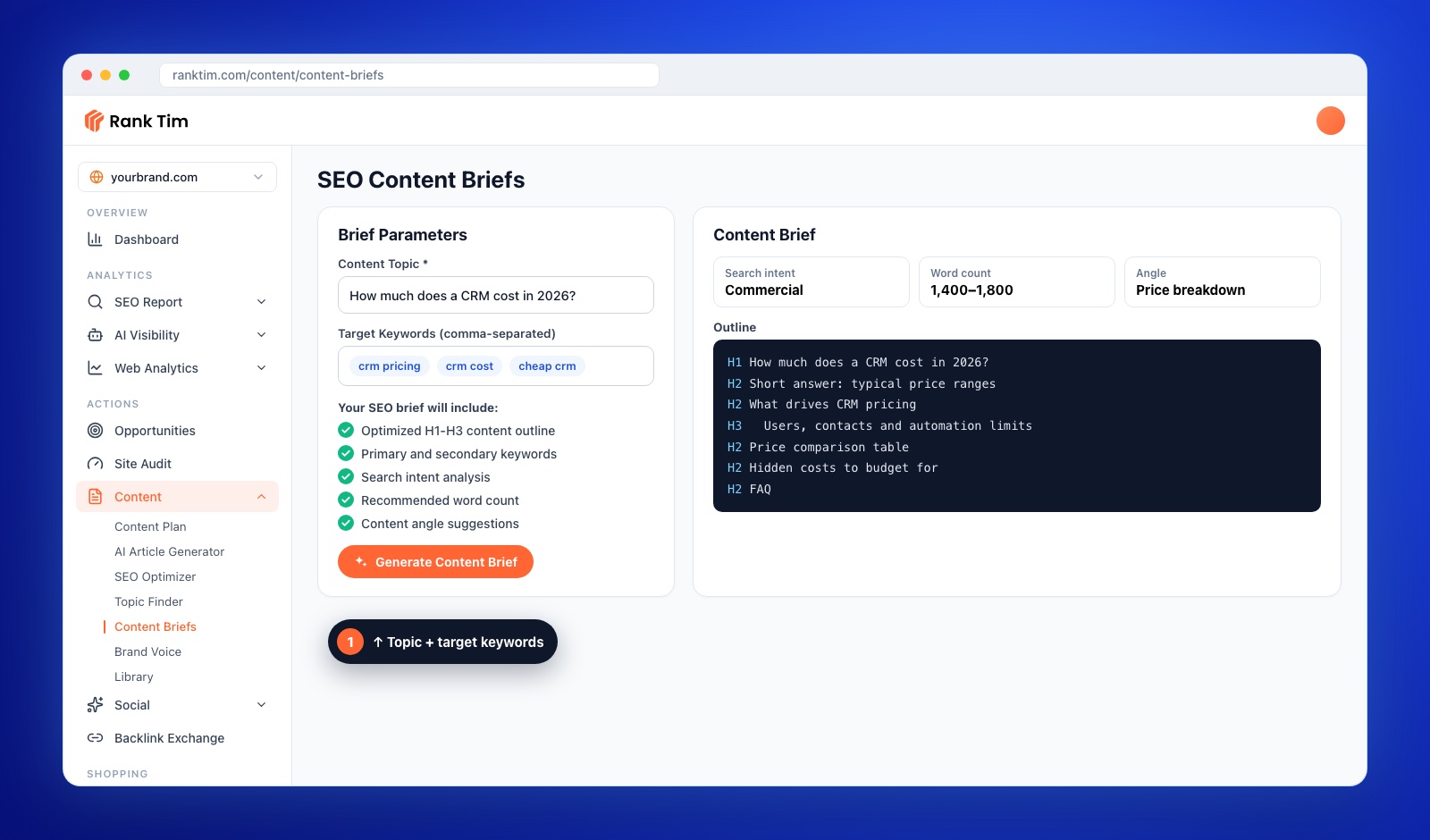
For each page owner, write a one-sentence promise: “After reading this page, the visitor can…” If you cannot finish that sentence clearly, the cluster is still too broad.
Step 7: Convert the Map into Trackable AI Prompts
Select the questions that matter most commercially and turn them into a prompt set. Start with 20–30 prompts, not 200. A small, representative set is easier to read and more useful for weekly decisions.
Include variations that test:
- Different buyer roles
- Different levels of expertise
- Different locations or markets
- Different budgets and team sizes
- Brand-free discovery questions
- Competitor comparisons
- Branded evaluation questions
Keep a stable “core” set for trend reporting. Add experimental prompts separately so a new idea does not distort your baseline.
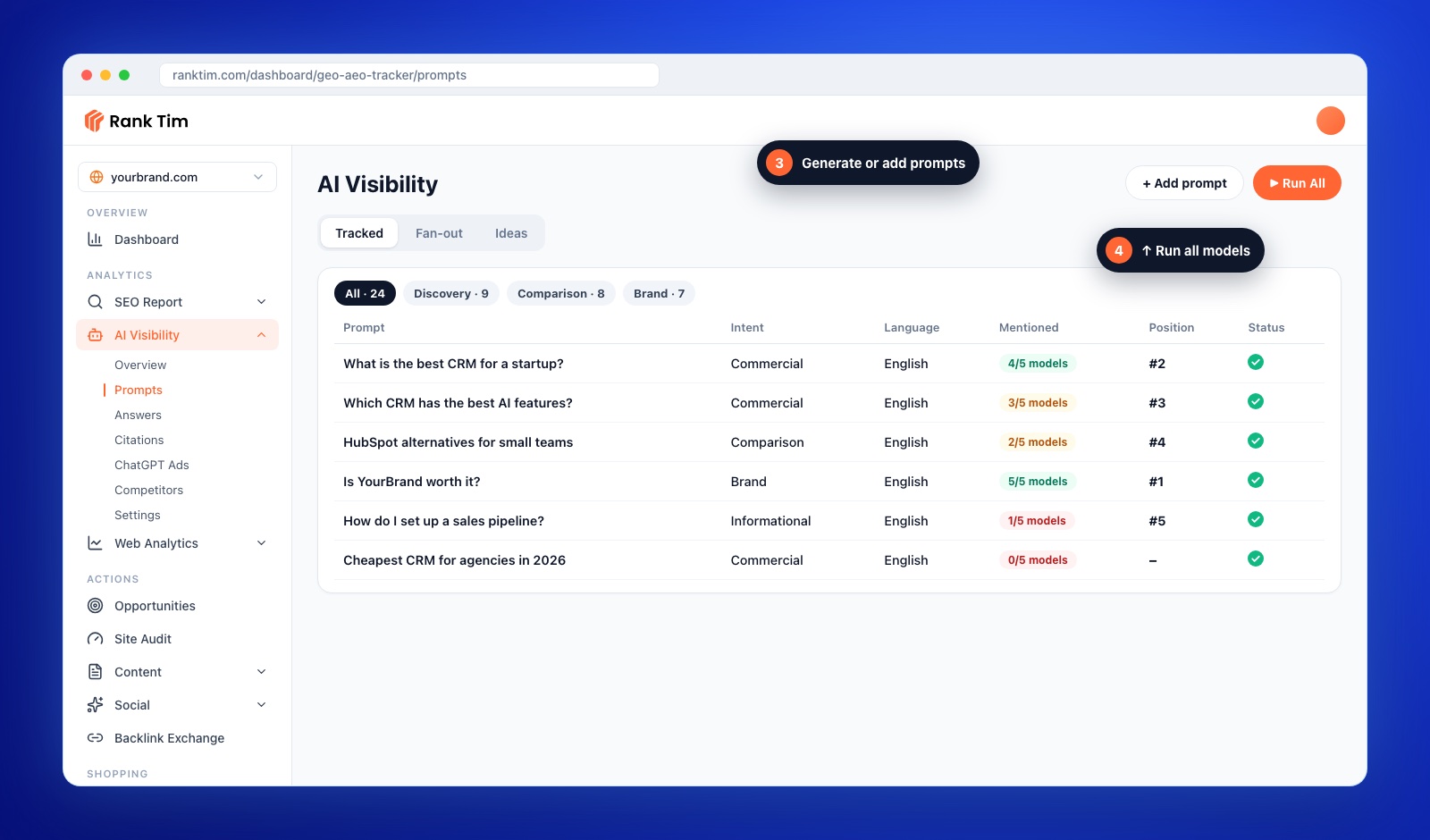
Run the same core prompts across ChatGPT, Gemini, Perplexity, Copilot and Google AI where available. Read the full answers for a sample of prompts, not only the scores. The wording shows whether the problem is missing content, weak evidence, inconsistent brand facts or a source gap outside your own website.
Step 8: Add the Citation and Content Gap Layer
For each prompt where you are absent, record three things: which competitor was mentioned, which URL was cited and what information the cited page contributed.
This turns a visibility gap into a content decision:
- If a competitor guide is cited because it has a clear definition, improve the explanation on your page.
- If a review site is cited because it compares vendors, build or earn a presence on that source.
- If your brand is mentioned but your page is not cited, make the relevant proof easier to retrieve and quote.
- If the answer contains an outdated fact, align your website, schema and third-party profiles.
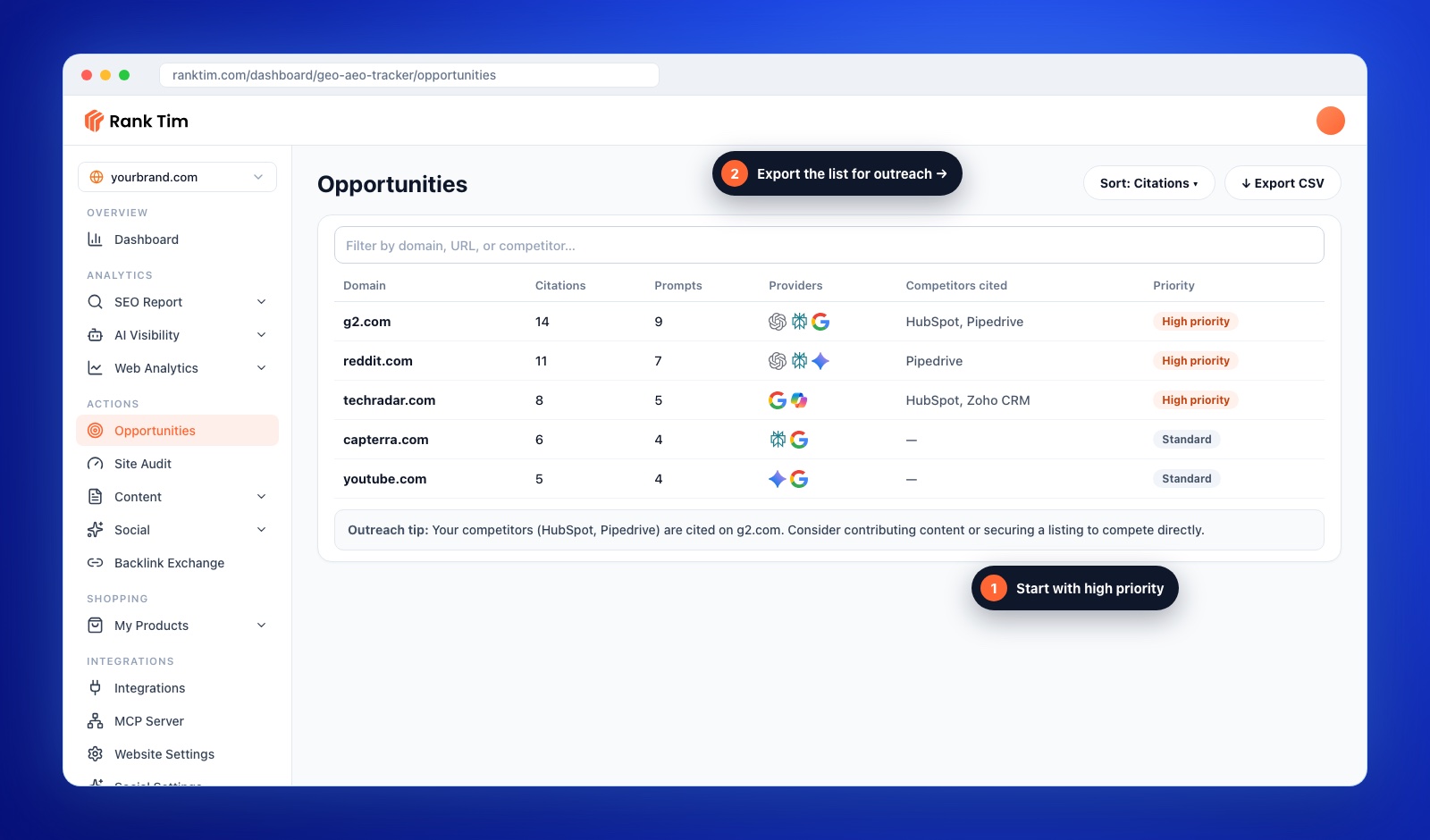
The point is not to force every question onto your own blog. Some gaps require product-page improvements, documentation, reviews, partnerships or outreach. The map should tell you which type of work has the best chance of changing the answer.
Step 9: Review the Map Every Week
Set a 15-minute weekly routine:
- Check the core prompt results and note meaningful changes.
- Add new questions from sales, support and Search Console.
- Merge duplicates and retire questions that no longer reflect the market.
- Mark the pages that were published or refreshed.
- Compare visibility and citations against the previous run.
- Choose one content action and one off-site action for the next week.
Do not judge the map by how large it becomes. Judge it by whether it helps you decide what to publish, what to improve and where to build evidence.
A Simple Spreadsheet Template
Create these columns in a spreadsheet or content planning tool:
| Column | Example |
|---|---|
| Customer question | How do I track brand mentions in ChatGPT? |
| Long-tail modifier | For a small local business |
| Intent | Learn / Choose / Validate / Act |
| Audience | Local marketing manager |
| Primary page | /blog/track-brand-mentions-chatgpt |
| Target keyword | track brand mentions in ChatGPT |
| AI prompt | What is the best way for a local business to track brand mentions in ChatGPT? |
| Competitors cited | Competitor A, review site B |
| Current visibility | Mentioned 1 of 5 models |
| Next action | Add a local-business example and run weekly tracking |
This format is deliberately practical. It connects the research input to the page, the prompt and the next action, so the keyword map does not become a document that nobody opens after the planning meeting.
Frequently Asked Questions
How many long-tail questions should one article target?
Start with one primary question and a small group of closely related variations. If the audience, intent or evidence changes substantially, create a separate page and link the two pages together.
Are long-tail keywords still useful when people ask AI instead of Google?
Yes. Long-tail keywords are useful shorthand for the detailed needs inside a conversational question. The important shift is to preserve the context behind the phrase and monitor the full prompt as well as the search query.
Should every customer question become a blog post?
No. Some questions belong in a product page, documentation, pricing page, comparison page, FAQ or support article. Assign each cluster to the page type that can answer it with the strongest evidence.
How do I know if a question deserves its own page?
Create a separate page when changing the audience, constraint or intent would change the answer, the proof required or the next action. Otherwise, keep it as a section or example on the stronger parent page.
What should I measure after publishing?
Track traditional performance such as impressions, clicks and conversions, then add AI visibility signals: brand mentions, answer position, sentiment, cited URLs and share of voice. The combination tells you whether the page is being found, chosen and trusted.
A long-tail keyword map is valuable because it gives your content team a shared view of demand, intent and evidence. It also gives your AI visibility program a stable set of questions to monitor. Start with the language your customers already use, add only the context that changes the answer and let the results decide what you publish next.
Find the Questions Your Customers Ask AI
Discover long-tail topics, turn them into focused SEO articles and see which pages earn visibility and citations across ChatGPT, Gemini, Perplexity, Copilot and Google AI.
Start Your Free Trial
Catalin Dinca
Written by Catalin Dinca