

Zero-Click Search: How to Win Visibility When AI Answers First
 Catalin Dinca
For most of SEO's history, the goal was simple: rank, get the click, convert the visitor. In 2026, a growing share of searches never produce that click. The answer appears on the results page, inside an AI Overview, a featured snippet, a knowledge panel or a ChatGPT reply, and the user moves on.
That is zero-click search. It is not a temporary dip in your analytics. It is a structural change in how people get information, and it rewards a different kind of strategy.
The brands that adapt are not the ones fighting to win back every lost click. They are the ones making sure that when the answer appears, their name is in it.
What Is Zero-Click Search?
A zero-click search is a search that ends without the user clicking through to any external website. The need is satisfied directly on the results page or inside an AI assistant's answer.
Common zero-click formats include:
- AI Overviews and AI Mode in Google, which summarize an answer and cite a few sources.
- Featured snippets that quote a paragraph, list or table from one page.
- Knowledge panels for brands, people and places.
- People Also Ask boxes that expand into answers.
- Direct answers for weather, conversions, calculations, sports scores and definitions.
- Local packs where users call or get directions without visiting a website.
- AI assistants like ChatGPT, Perplexity and Gemini, where the whole interaction may never touch a search results page.
What the Data Shows
Zero-click behavior was already the majority before AI summaries became widespread. SparkToro's 2024 study, based on clickstream data from Datos, found that 58.5% of Google searches in the US and 59.7% in the EU ended without a click. For every 1,000 US searches, only 360 clicks went to the open web.
AI summaries accelerate the trend. In July 2025, Pew Research Center published an analysis of real browsing behavior from 900 US adults:
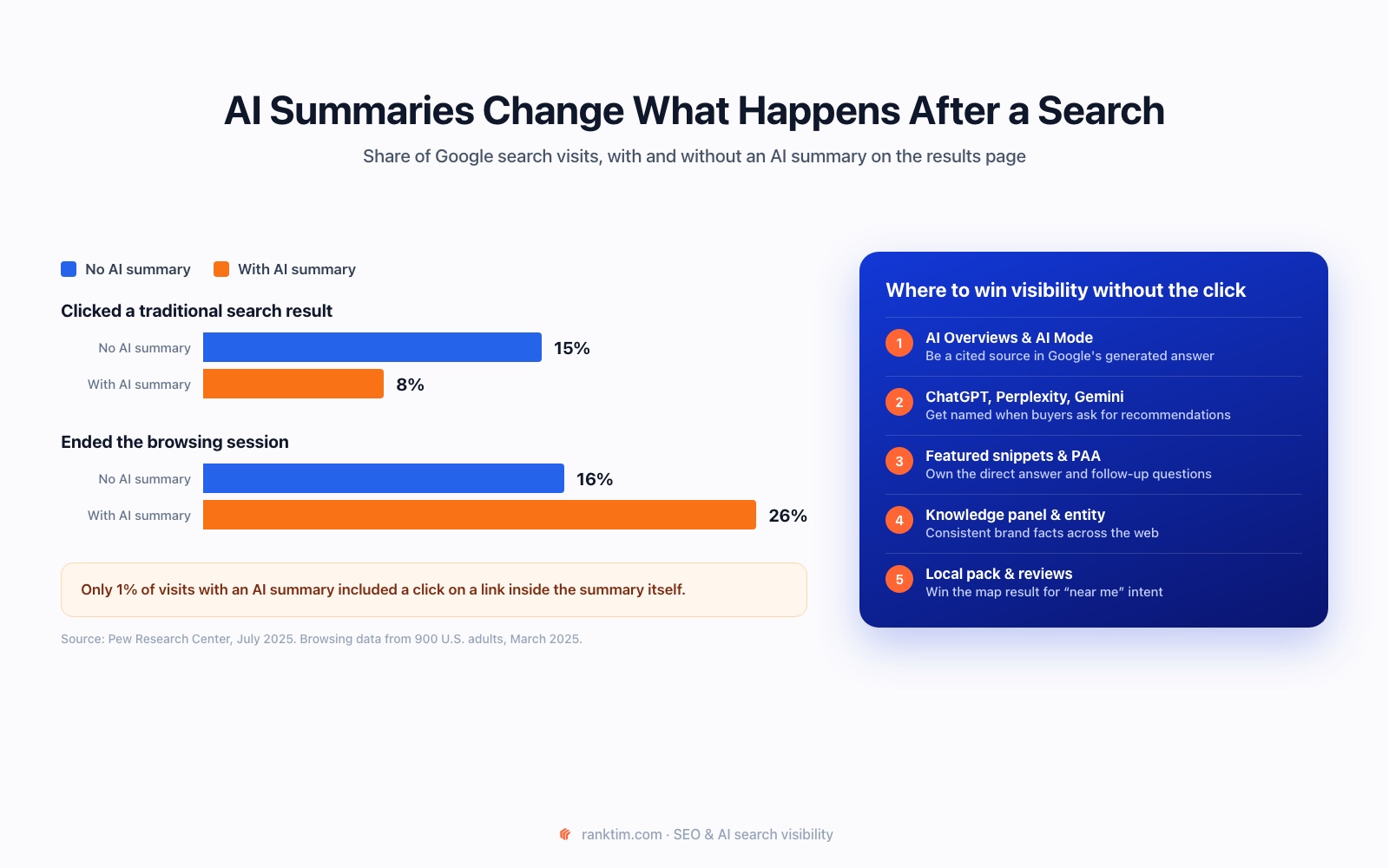
- With an AI summary on the page, users clicked a traditional result in 8% of visits, compared with 15% when no summary appeared.
- Only 1% of those visits included a click on a link inside the AI summary itself.
- Users ended their browsing session more often after a results page with an AI summary (26% versus 16%).
Ahrefs reached a similar conclusion from the publisher side: in a 2025 study of 300,000 keywords, the presence of an AI Overview was associated with a 34.5% lower click-through rate for the top-ranking page.
The pattern is clear. On informational queries, fewer people click. But they still read, and what they read shapes which brand they trust, remember and eventually search for by name.
Why Zero-Click Does Not Mean Zero Value
When a user reads an AI answer that recommends your product, three valuable things happen without a click:
- Your brand enters their consideration set at the exact moment they are researching.
- Your claims get third-party framing. Being cited by Google or ChatGPT feels more neutral than your own ad.
- Demand shows up later, as branded searches, direct visits and conversions that analytics often attribute to "direct" or "branded organic".
The clicks that do happen also tend to be better qualified. Someone who clicks after reading a summary already understands the basics and wants depth, a tool, a price or a demo.
This is why the right question is no longer "how do we get every click back?" but "how do we own the answer, and give people a reason to click when they are ready?"
7 Strategies to Win in a Zero-Click World
1. Get cited inside AI answers
AI Overviews and assistants draw from pages that rank well, answer clearly and are corroborated by other sources. Our guide to AI visibility covers the fundamentals in depth, but the short version is:
- Answer the question in the first one or two sentences of the relevant section.
- Cover the sub-questions behind a query, because AI systems fan out a single prompt into several related searches.
- Use structured formats (tables, numbered steps, short definitions) that are easy to extract accurately.
- Make your entities unambiguous with consistent facts and schema markup.
2. Build brand mentions where AI looks
AI assistants form their view of a category from many sources: review platforms, "best of" lists, Reddit threads, YouTube videos, industry publications. Being mentioned consistently across those sources is one of the strongest signals for appearing in AI recommendations. Our practical audit on why competitors get cited by ChatGPT and your brand doesn't shows how to find and close those gaps.
3. Own featured snippets and People Also Ask
Featured snippets and PAA boxes are still prime real estate, and they often feed AI answers too. Target question-based queries, answer each in 40 to 60 words directly under a matching subheading, then expand with depth below.
4. Strengthen your entity and knowledge panel
When someone searches your brand, the results page itself is your homepage. Keep your name, description, logo, founders, pricing basics and social profiles consistent across your website, Google Business Profile, LinkedIn, Crunchbase, review sites and Wikidata where relevant. Inconsistencies confuse both knowledge panels and AI assistants.
5. Create content that cannot be summarized away
AI can summarize a definition. It cannot replace an interactive calculator, a free tool, a template, original research with downloadable data, or a detailed product comparison with real screenshots. Build at least part of your content around assets that require a visit to get the full value. Summaries then work as previews that send qualified clicks your way.
6. Win local and visual results
For local businesses, the map pack is often the entire result. Complete and update your Google Business Profile, collect reviews consistently and answer them. For product and how-to queries, optimize images and video, which increasingly appear in both classic and AI results.
7. Refresh the pages that AI already cites
Assistants favour current sources. If a page of yours is cited today, keep it accurate and current so it stays cited. Our content refresh strategy guide explains how to spot and fix decaying pages.
Measure the visibility your analytics can't see
RankTim's AI Visibility tool shows how often ChatGPT, Gemini, Perplexity and Google AI mention your brand, which pages they cite and how you compare to competitors.
Check Your AI VisibilityChange How You Measure Success
If clicks are your only KPI, a zero-click world will always look like decline. Add metrics that reflect visibility, not just visits:
| Classic Metric | Zero-Click Era Metric | Where to Get It |
|---|---|---|
| Organic clicks | Impressions and average position for priority queries | Google Search Console |
| Keyword rankings | AI visibility: share of prompts where your brand is mentioned | AI visibility tracking across models |
| Backlinks | AI citations: how often your pages are used as sources | Citation tracking per prompt and model |
| Market share by traffic | Share of voice versus competitors in AI answers | Competitor comparison in AI responses |
| Referral traffic | Branded search growth and AI referral sessions | Search Console, GA4 with LLM tracking |
Two of these are easy to start with today. In Search Console, track the growth of branded queries over time: it is one of the best indirect signals that zero-click exposure is working. In GA4, set up a channel for AI assistants so you can see the clicks that do come from them. Our guide on tracking LLM traffic in GA4 shows the exact configuration.
Track Zero-Click Visibility with RankTim
The hardest part of zero-click SEO is that the most important exposure never shows up in your analytics. RankTim's GEO / AEO Tracker fills that gap. It runs the prompts your buyers ask across ChatGPT, Gemini, Perplexity, Copilot and Google AI, then reports your AI visibility, share of voice, brand mentions, average mention position and sentiment, with trends over time.
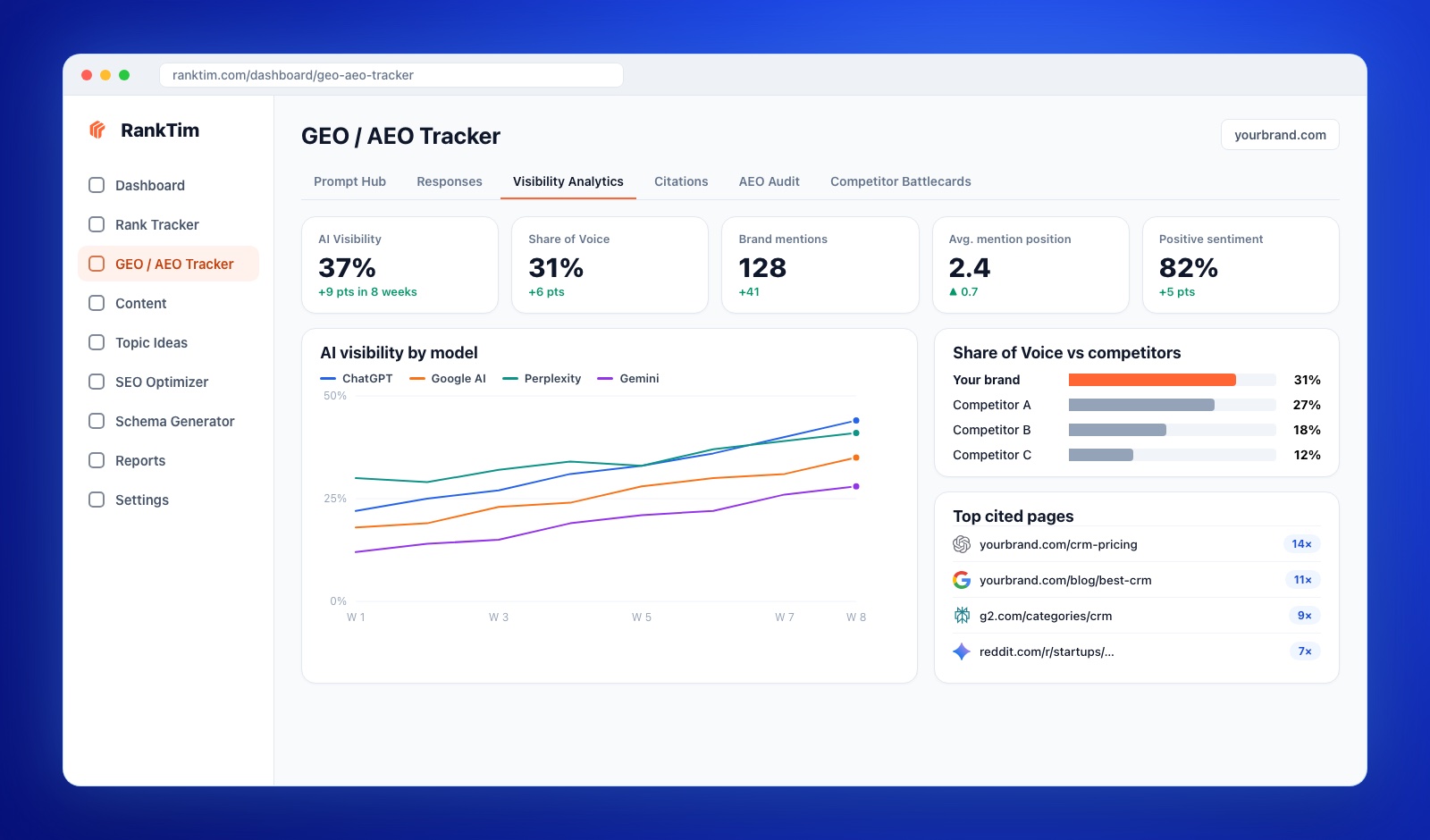
You see which of your pages are cited, which competitor pages are cited instead, and which prompts you are missing entirely. Combined with daily keyword tracking in the Rank Tracker and page-level recommendations in the SEO Optimizer, it turns "we are losing clicks" into a concrete list of pages and prompts to work on.
Frequently Asked Questions
What is a zero-click search?
A search that ends without the user clicking through to any external website, because the answer is shown directly on the results page or inside an AI assistant's response.
What percentage of searches are zero-click?
SparkToro's 2024 study found that 58.5% of US Google searches and 59.7% of EU searches ended without a click. Pew Research data from 2025 shows that clicks on traditional results drop further when an AI summary appears.
Are zero-click searches bad for SEO?
They reduce clicks on many informational queries, but they do not remove the value of visibility. Being the cited or featured answer builds awareness and trust that later turns into branded searches and conversions. The goal shifts from ranking alone to owning the answer.
How do I optimize for zero-click searches?
Answer questions clearly at the top of each section, target featured snippets and People Also Ask, build consistent brand mentions across trusted sources, use structured data, and create assets like tools and original data that people need to visit to use.
How can I measure visibility if users don't click?
Track impressions and branded query growth in Search Console, AI referral sessions in GA4, and your mentions, citations and share of voice in AI answers with an AI visibility tracker.
Zero-click search is not the end of SEO. It is the end of measuring SEO only by clicks. The brands that win from here are the ones that show up in the answer, earn trust before the visit, and make the click worth it when it finally comes.
Win the Search, Even When Nobody Clicks
Track your rankings, AI citations and share of voice in one dashboard, and see exactly which prompts and pages to work on next.
Start Tracking for Free
Catalin Dinca
Written by Catalin Dinca