

AI Visibility: What It Is and How to Get Your Brand Featured in 2026
 Catalin Dinca
Imagine two brands competing in the same software category. Both have spent years building organic search presence. Both rank in Google's top five for their most valuable keywords. But when a potential customer opens ChatGPT and asks which solution fits their specific situation, only one brand is mentioned — named clearly, described accurately, and recommended with confidence. The other does not appear at all.
That scenario is not hypothetical. It is happening across every industry right now, and the gap it represents is called AI visibility. In 2026, it is one of the most consequential and most overlooked gaps in modern digital marketing. Understanding it — and acting on it — separates brands that grow from brands that gradually become invisible to their own audience.
What Is AI Visibility?
AI visibility is the measure of how often, how consistently, and how favorably your brand appears in responses generated by AI platforms. The platforms that matter most right now are ChatGPT, Perplexity, Google AI Mode, and Gemini — but the ecosystem is expanding, and brands that build AI visibility today will carry that advantage as new platforms emerge.
When a user asks any of these platforms to recommend a tool, compare competing services, identify the best solution for a defined workflow, or explain which companies lead a particular category, AI visibility determines two things simultaneously: whether your brand appears at all, and what is said about it when it does.
This makes AI visibility meaningfully different from a search ranking. A search ranking tells you how high your page sits in a list. AI visibility tells you whether your brand is part of the answer — part of the synthesized recommendation that a user receives, reads, and acts on. Those are different forms of presence with different business implications.
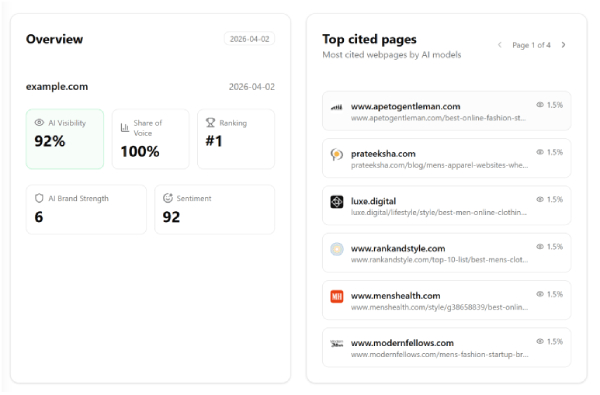
The dimensions of AI visibility worth tracking are: mention frequency across a representative set of relevant queries, competitive position within responses, sentiment and accuracy of surrounding language, and whether the mention includes a link back to your site. Together, these four dimensions give you a complete picture of where your brand stands in AI-generated conversations about your category.
The Gap That Most Brands Are Not Measuring
One of the most important findings to emerge as AI search has matured is that strong Google performance does not reliably predict strong AI citation. The two channels are related but they are not the same, and the overlap between them is smaller than most marketers assume.
Research comparing top Google results against pages actually cited by major AI platforms found that fewer than half of pages ranking in the top positions ever appeared in an AI-generated answer for the same topic. The inversion goes in the other direction too — pages with modest search rankings sometimes become frequently cited AI sources because of how they are written and how broadly the brand is discussed externally.
The structural reason for this gap is that search engines and AI systems optimize for different things. Search engines reward relevance, technical quality, and authority signals within their ranking algorithms. AI systems reward extractability — the ability to pull a specific, confident claim from a piece of content — as well as third-party credibility signals and brand description consistency across the whole of the web. A brand can nail traditional SEO and still systematically miss AI citation because its content is written to rank rather than to be extracted, and because its external presence is built around backlinks rather than independent editorial coverage.
This is why AI visibility needs to be measured and optimized separately. Assuming that your SEO performance is a proxy for your AI visibility is a costly assumption, and the brands making it are quietly losing ground in a channel that is growing fast.
Why Being Featured in AI Answers Changes Your Revenue Equation
The business case for AI visibility is not about impressions or awareness in the abstract sense. It is about the specific quality of the users that AI platforms send when they do recommend your brand.
When someone asks an AI platform to recommend solutions in your category, they have already made a decision to research. They are in evaluation mode — actively comparing, narrowing options, forming preferences. The AI platform's response is the shortlist they use to structure their next steps. By the time they click through to a brand's site from an AI answer, they carry context that organic search visitors typically do not have: they know what the brand does, they have already seen how it compares to alternatives, and they have received a recommendation. That is a fundamentally different kind of visit.
Brands that track AI referral traffic separately from general organic traffic consistently observe the same pattern: higher engagement rates, longer session durations, and significantly better conversion rates from AI-referred visitors. The effect is most pronounced for high-intent commercial queries — exactly the queries where your brand most needs to appear. A visitor who found you because an AI platform recommended you for their specific use case is not browsing. They are evaluating with intent to decide.
This changes the revenue math for AI visibility investment in a meaningful way. Growing your presence in AI-generated answers for the right queries is not a brand awareness play that pays off eventually. It is a direct acquisition investment that sends qualified prospects further along in their decision process than almost any other organic channel delivers.
How AI Systems Decide Which Brands to Feature
To improve AI visibility, you need to understand the mechanisms that determine which brands get cited and which get skipped. These mechanisms differ in their specifics across platforms, but three underlying patterns appear consistently.
Content that makes direct, extractable claims gets cited more reliably. AI systems synthesize answers by pulling specific statements from source content. When a piece of content states clearly and confidently what a product does, who it is best suited for, what problem it solves, and how it compares to alternatives, the AI system has clean, high-confidence material to work with. When content hedges every claim, speaks in generalities, avoids direct comparisons, and buries its main points inside qualifications, the AI system cannot extract useful statements from it easily — and so it relies on other sources instead. This is a content structure and writing discipline problem, not a technical SEO problem.
Third-party credibility signals shape what AI systems believe about your brand. AI platforms do not rely solely on your own properties when forming their picture of what your brand is and how it is regarded. Independent reviews, editorial coverage in credible publications, mentions in authoritative forums, analyst commentary, and expert roundups all contribute to the external signal landscape that AI systems draw from when assessing which brands to include and how to describe them. A brand with excellent owned content but thin independent coverage is consistently disadvantaged against a brand with similar content but a richer external presence.
Each platform has its own citation tendencies, and they vary enough to matter. ChatGPT and Perplexity have different training data, different real-time retrieval mechanisms, and different patterns in how they weight sources and construct recommendations. A brand that performs strongly on Perplexity for a given query type may barely register on ChatGPT for the same queries, and vice versa. These are not random variations — they reflect structural differences in how each platform was built and how it retrieves current information. Treating all AI platforms as interchangeable produces a strategy that is optimized for none of them.
Building Your AI Visibility Measurement System
Before any optimization effort makes sense, you need a measurement system that tells you where you currently stand. Most brands that begin working on AI visibility discover that their starting point is significantly weaker than they expected, and that competitors they considered to be peers have already built meaningful leads in specific platforms or query types.
Define the Query Set That Represents Your Audience's Research Behavior
Effective AI visibility measurement is built on prompts that mirror how your actual target audience asks questions in your category. These are not keyword lists — they are conversational questions that cover the full range of research intent your prospective customers move through.
A useful prompt set covers four types. Category queries are broad: "best tools for X" or "top platforms for Y." Use-case queries are more specific: "which solution is best for a team that needs Z" or "what platform handles W most efficiently." Comparison queries name competitors directly: "brand A versus brand B for use case C." Evaluation queries probe quality and reliability: "is brand X worth it" or "brand X reviews" or "brand X alternatives."
Build fifteen to thirty prompts across these types that represent the questions your highest-value prospects are most likely to ask. This set becomes the consistent measurement instrument for your AI visibility tracking — the same prompts, tracked across the same platforms, at regular intervals so that trend data becomes meaningful over time.
Track the Four Dimensions That Actually Capture AI Visibility
For each prompt across each platform, you are recording four things. Presence: does your brand appear in the response at all, or is it absent? Position: where does your brand appear in relation to competitors — first, second, after three other brands, as an afterthought in the final sentence? Sentiment: what language surrounds the mention — is your brand described as a recommended option, a viable alternative, or something users might consider for limited use cases? Attribution: does the response include a link to your site, or is the mention unlinked?
Manual spot checks across this framework are feasible at very small scale, but they have a fundamental limitation: AI responses for identical prompts vary between sessions because of how language models generate output. A single manual check gives you a point-in-time snapshot, not a reliable picture of how consistently your brand appears across the distribution of responses a prompt generates. Automated tracking that runs prompts on a regular schedule and aggregates results over multiple sessions is the only way to build accurate, actionable visibility data.
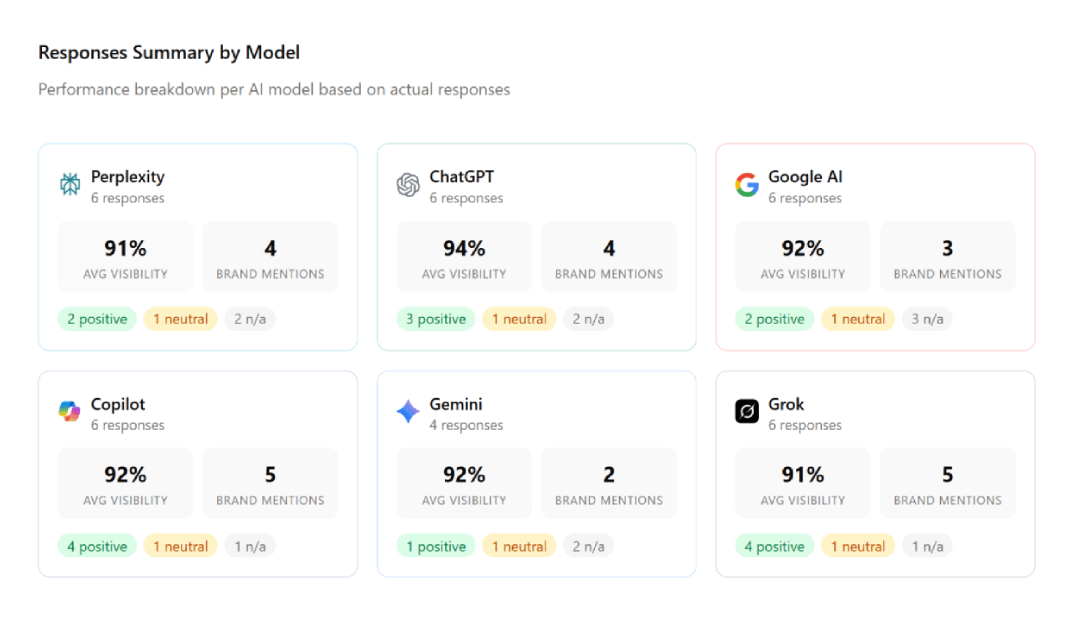
RankTim automates this measurement system. Configure your prompt set, specify the platforms you want to track, and RankTim runs each prompt on a regular schedule — recording mention rate, competitive position, sentiment classification, and link attribution for every response. Over weeks and months, this data builds the trend line and the platform-level breakdown you need to make optimization decisions based on evidence rather than intuition.
Benchmark Against Competitors Before You Prioritize Anything
Your raw mention rate is not meaningful in isolation. A 40% mention rate across your target prompts represents a strong position if your closest competitors average 20%, and a significant gap if they average 75%. Competitive benchmarking transforms a number into a strategic signal.
Platform-level competitor analysis is where AI visibility benchmarking becomes most actionable. A brand might be performing strongly on Perplexity — appearing consistently and early in responses — while being nearly absent from ChatGPT for the same queries. That gap is not random. It reflects a specific deficit in either content structure or external signal that ChatGPT's retrieval mechanisms respond to differently from Perplexity's. Knowing which platform the gap is largest on tells you exactly where to direct optimization effort first.
Five Actions That Grow AI Visibility
Rewrite Content to Lead With the Answer
The structural shift that produces the fastest AI visibility improvement for most brands is moving the main point to the top of every content section. AI systems extract answers from source content — they do not process a full article and synthesize its overall argument. They pull specific statements to insert into their response. If the most citable statement in a section is buried in paragraph four after three paragraphs of context-setting, it competes poorly against a competitor whose content leads with the same claim stated clearly and directly.
Review your highest-traffic pages section by section. For each section, identify the core claim it is making and move that claim to the first sentence. Then provide supporting detail, context, and nuance after the lead statement. This structural change does not require rewriting content from scratch — it requires reorganizing how existing content is presented. For many brands, this single discipline applied consistently across their most important pages produces measurable AI citation improvement within a month or two.
Build External Coverage in the Sources AI Platforms Already Cite
Because AI systems weigh independent third-party coverage heavily when assessing brand credibility, earned media in the right publications is one of the highest-leverage investments you can make for AI visibility. The key word is right — not all coverage is equally valuable for AI citation purposes. A mention in a publication that AI platforms already cite frequently in your category has far more impact than coverage in a publication that AI systems rarely draw from.
The most precise way to build this targeting list is to identify which external sources appear most frequently when AI platforms discuss your category. If you can see which publications and review platforms consistently come up in AI answers for the queries your audience asks, those are the sources where you need to earn coverage. RankTim's Source Attribution feature makes this targeting process explicit — showing you which external sites are being cited in AI responses in your category so that your PR and earned media investments are aimed directly at the sources that drive AI citation, not at sources that only serve traditional backlink purposes.
Refresh Your Highest-Value Pages on a Quarterly Cadence
AI platforms with live retrieval capabilities consistently prefer recently updated content over content that has not been touched in months or years. A page that was comprehensive and well-written when first published eighteen months ago is competing against updated versions from competitors, and in many cases losing that competition in AI citation frequency even when it still holds its search ranking.
Build a quarterly content review into your standard workflow. For each of your most important pages, check whether statistics need updating, whether comparison sections still accurately reflect the competitive landscape, whether new questions have emerged in your category that the page should address, and whether any claims have become outdated. These are targeted edits — not full rewrites — but they signal recency to AI retrieval systems and keep the content competitive against more recently updated alternatives.
Audit Brand Description Consistency Across Every Channel
AI systems encounter your brand across a wide range of sources: your own website, third-party review platforms, directory listings, social profiles, press coverage, forum discussions, analyst commentary, and more. When all of those sources describe your brand in consistent terms — using the same positioning, the same description of what you do and who you serve, the same framing of your core value proposition — the AI system forms a clear, confident picture of your brand that it can draw from reliably.
When those descriptions conflict — different positioning on the homepage versus the about page, outdated descriptions on directory listings, press coverage that describes a product feature you no longer offer, social profiles that have not been updated to reflect a repositioning — the AI system's understanding becomes fragmented. Audit your homepage, about page, product pages, top directory listings, and social profiles. Bring them into alignment. This is not a glamorous optimization, but it directly improves the reliability and accuracy of AI citations for your brand.
Implement Structured Markup Across Every Relevant Page Type
Schema markup provides AI crawlers with explicit, machine-readable signals about what a page contains and what claims it makes. FAQ schema is particularly valuable because it formats question-and-answer pairs in a structure that maps directly onto how AI systems construct responses to user questions. Article schema, Product schema, and Organization schema each provide categorization signals that help AI systems understand and extract from your content with confidence.
If your site is not using structured data consistently, implementing it is a relatively straightforward technical investment that benefits both AI visibility and traditional SEO simultaneously. Start with your highest-traffic pages and your most important product and comparison pages, then extend coverage systematically across the rest of the site.
Growing AI Visibility as a Managed Program with RankTim
AI visibility is not a configuration you set once and leave alone. AI models update on their own schedules, training data refreshes, competitor content and external coverage evolves, and the queries your audience asks AI platforms shift as AI search behavior matures. A brand that was performing strongly three months ago can lose ground quietly if competitors invest while it stays static.
That is why tracking infrastructure matters as much as the optimization work. RankTim's dashboard provides the continuous measurement that makes growth visible and keeps optimization targeted to what is actually moving. You can see how mention rate, sentiment, and competitive position change week over week across each platform. You can identify which specific prompts are improving and which remain stuck. The Competitor Intelligence dashboard shows you exactly where competitors appear in AI answers that your brand does not, broken down by platform and query type. And the Source Attribution feature turns competitor gap analysis into a precise targeting list — these are the publications and platforms where your competitors earn citations that your brand is missing, and they become the priority targets for your earned media program.

Together, measurement, competitive benchmarking, and source attribution give you the ability to run AI visibility as a managed growth program rather than a series of disconnected experiments. The brands building this infrastructure in 2026 are creating compounding advantages — each improvement in citation frequency increases the signal strength that reinforces future citation, and each piece of earned coverage in an AI-cited source adds durable authority that accumulates over time.
AI Visibility FAQs
What is AI visibility and how is it different from SEO?
AI visibility measures how often and how favorably your brand appears in AI-generated responses on platforms like ChatGPT, Perplexity, Google AI Mode, and Gemini. Traditional SEO measures how highly your pages rank in search engine results. The two are related but require distinct optimization approaches — strong search rankings do not automatically produce strong AI citation, and the content structure and external authority signals that drive AI visibility are different from what drives search ranking.
Why should I prioritize AI visibility in 2026?
Because a growing and high-converting segment of your target audience is now researching purchase decisions inside AI platforms rather than on search results pages. Users who arrive at your site from an AI recommendation have already been through a comparison and narrowing process, making them significantly more likely to convert than the average organic search visitor. Being absent from AI-generated answers in your category means missing that acquisition channel entirely.
Does ranking well on Google guarantee AI visibility?
No. Research comparing top-ten Google results against pages actually cited by AI platforms found that fewer than half of high-ranking pages ever appeared in an AI answer. The content structure, external coverage signals, and brand description consistency that AI systems rely on require optimization work that is separate from and in addition to traditional SEO.
How often should I track AI visibility?
Weekly automated tracking is the practical standard for most brands. AI responses shift meaningfully within days of model updates, new content being indexed by retrieval systems, or changes in competitor coverage. Monthly manual checks miss these fluctuations. RankTim automates weekly prompt tracking across all major platforms, so the cadence does not require additional manual effort once configured.
What is the fastest way to improve AI visibility?
Two actions consistently produce the fastest results. First, restructure existing content so that every section leads with a direct, specific answer rather than building to it — this addresses the extractability problem that suppresses AI citation for most brands. Second, secure coverage in the publications and platforms that AI systems already cite most frequently in your category — this addresses the external authority gap. RankTim's Source Attribution feature identifies those priority publications directly from AI response data.
How can I find out where competitors are appearing in AI answers that I am not?
Run your target prompt set across the AI platforms that matter for your category and record which competitors appear in responses where you do not. RankTim's Competitor Intelligence dashboard does this automatically, showing you the specific queries and platforms driving competitor AI visibility that your brand is missing, so you can prioritize your optimization effort around the most impactful gaps.
Can smaller brands compete for AI visibility against large established competitors?
Yes, and often more effectively than in traditional search. AI systems favor content that is specific, direct, and authoritative on a well-defined topic over broad content from large domains. A smaller brand with focused, well-structured content on the queries that matter most for its audience, combined with consistent coverage in the right niche publications, regularly outperforms much larger but less precisely positioned competitors on those specific query types. Targeting the right prompts rather than competing broadly across an entire category is where smaller brands typically find their strongest leverage.

Catalin Dinca
Written by Catalin Dinca