

ChatGPT Ads: What They Mean for Brands and Organic AI Visibility
 Catalin Dinca
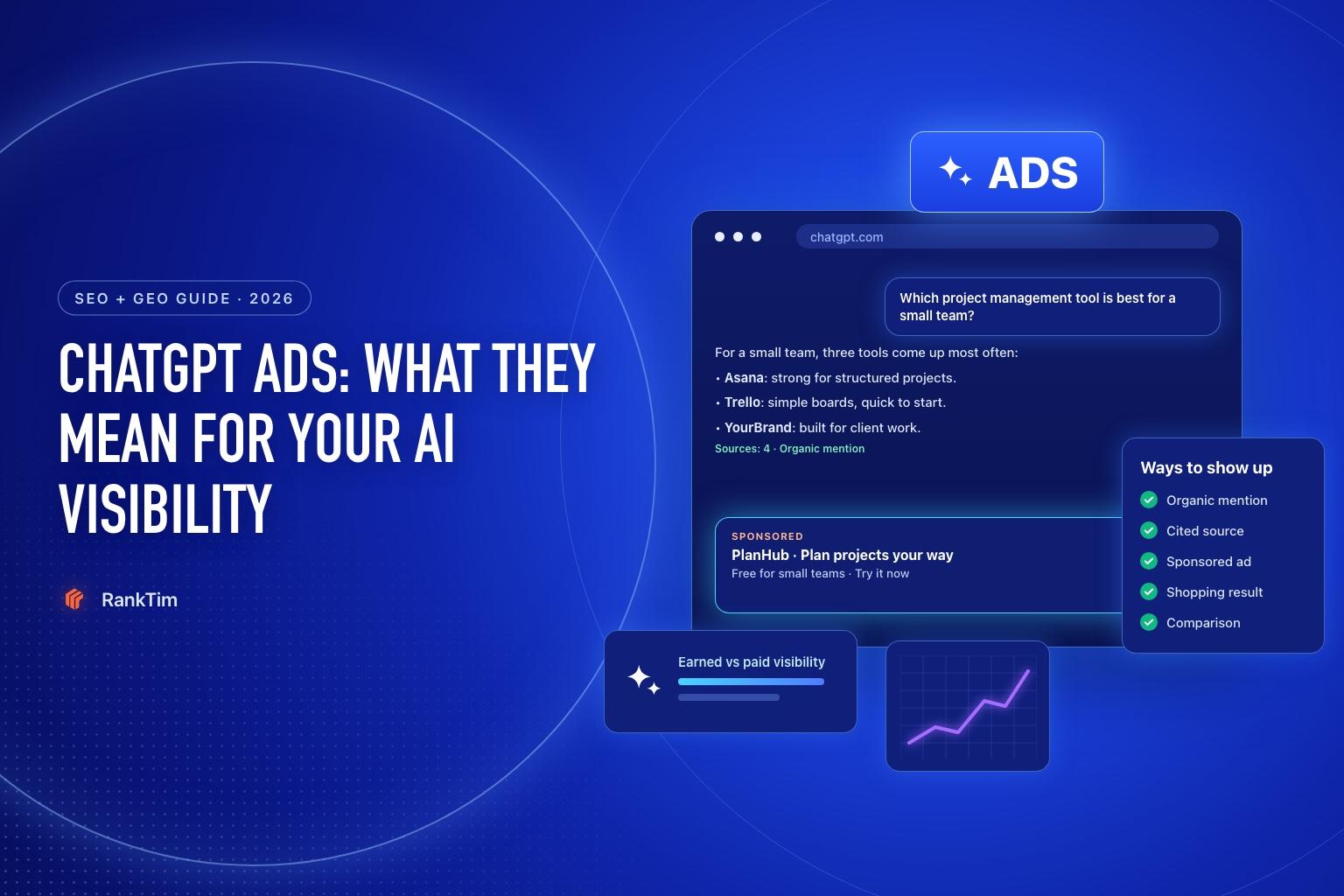
For the first few years, the only way to appear in a ChatGPT answer was to earn it: be a brand the model knows, be mentioned by sources it trusts and publish pages it can cite. In 2026 that changed. OpenAI started showing ads in ChatGPT.
Many marketers asked the same question: can AI visibility now be bought? The short answer is no, not the answer itself. But ads do change what buyers see around the answer, and they give competitors a new way to appear next to your category's most valuable questions.
This guide explains how ads in ChatGPT work, what they mean for brands and how to balance organic and paid visibility, based on what OpenAI has published and what you can measure.
How Ads in ChatGPT Work
OpenAI announced its approach to advertising in January 2026 and began testing ads with logged-in adult users in the US in February. Over the year, ads and the self-serve Ads Manager have expanded to more countries, including markets in Europe, so check OpenAI's advertiser pages for availability in yours. According to OpenAI's own principles and help center:
- Ads appear below the answer when there's a relevant sponsored product or service for the conversation.
- Ads are separate and clearly labeled as sponsored.
- Ads don't influence the answers. OpenAI states that answers are optimized for what's most helpful to the user, not for advertisers.
- Not every user sees ads. They may appear on the Free and Go plans. Plus, Pro, Business, Enterprise and Edu accounts don't show ads, and neither do Temporary Chats.
- Some contexts are excluded. OpenAI doesn't show ads to accounts it identifies as under 18, and ads aren't eligible near sensitive topics such as personal health, mental health or politics.
- Ads are matched to context: the topic of the conversation, past chats and past interactions with ads. Users can turn off personalization and clear ad data.
- Conversations stay private from advertisers. OpenAI says it doesn't sell user data to advertisers.
| Type of visibility | Where it appears | How you get it |
|---|---|---|
| Organic mention | Inside the answer, when ChatGPT names or recommends your brand | Earned: reputation, coverage, reviews, clear positioning |
| Citation | In the sources linked from the answer | Earned: useful, crawlable, well-structured pages |
| Sponsored placement | Below the answer, labeled as sponsored | Paid: an ad campaign in ChatGPT's Ads Manager |
Why Organic AI Visibility Still Matters Most
- The answer is where the decision happens. Users read the recommendation first. An ad below an answer that recommends your competitor is fighting uphill.
- Paying users never see ads. Plus, Pro, Business and Enterprise users are often the professionals and companies B2B brands want to reach.
- Ads only show in some contexts. Many prompts, topics and countries won't carry ads at all, while organic mentions can appear everywhere.
- Organic visibility compounds. A strong reputation in sources AI trusts keeps working across ChatGPT, Gemini, Perplexity and Google AI, without a budget per click.
That doesn't make ads useless. They can put a new brand in front of buyers before the model knows it well, or protect high-value prompts where competitors are already advertising.
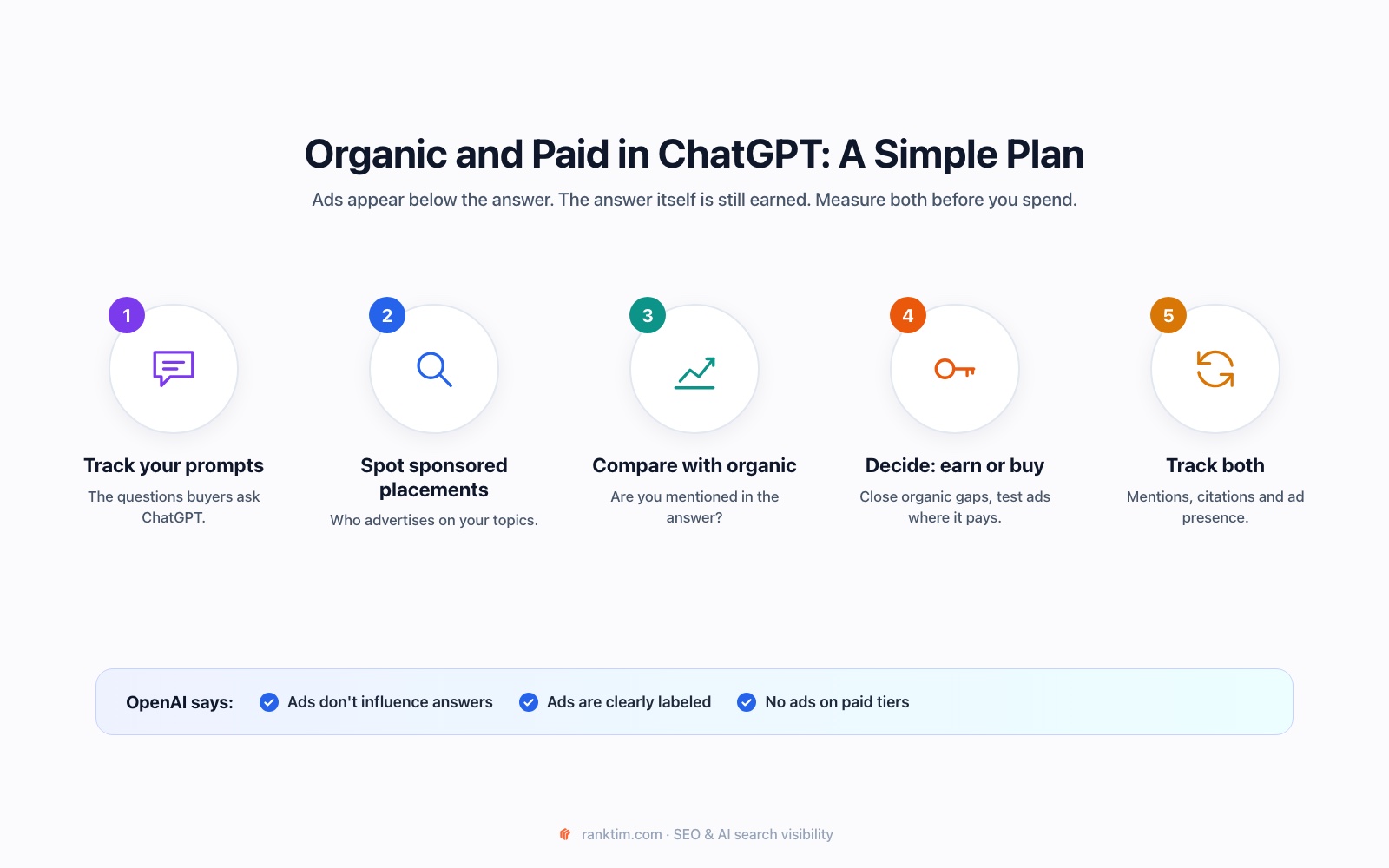
Step 1: Track the Prompts That Matter to Your Business
Start with the same foundation you use for organic AI visibility: a list of prompts your buyers actually ask, from "best [category] for [audience]" to "[competitor] alternatives". Our prompt research tutorial shows how to build it, and query fan-out explains how to expand it by persona.
Step 2: See Who Advertises on Your Prompts
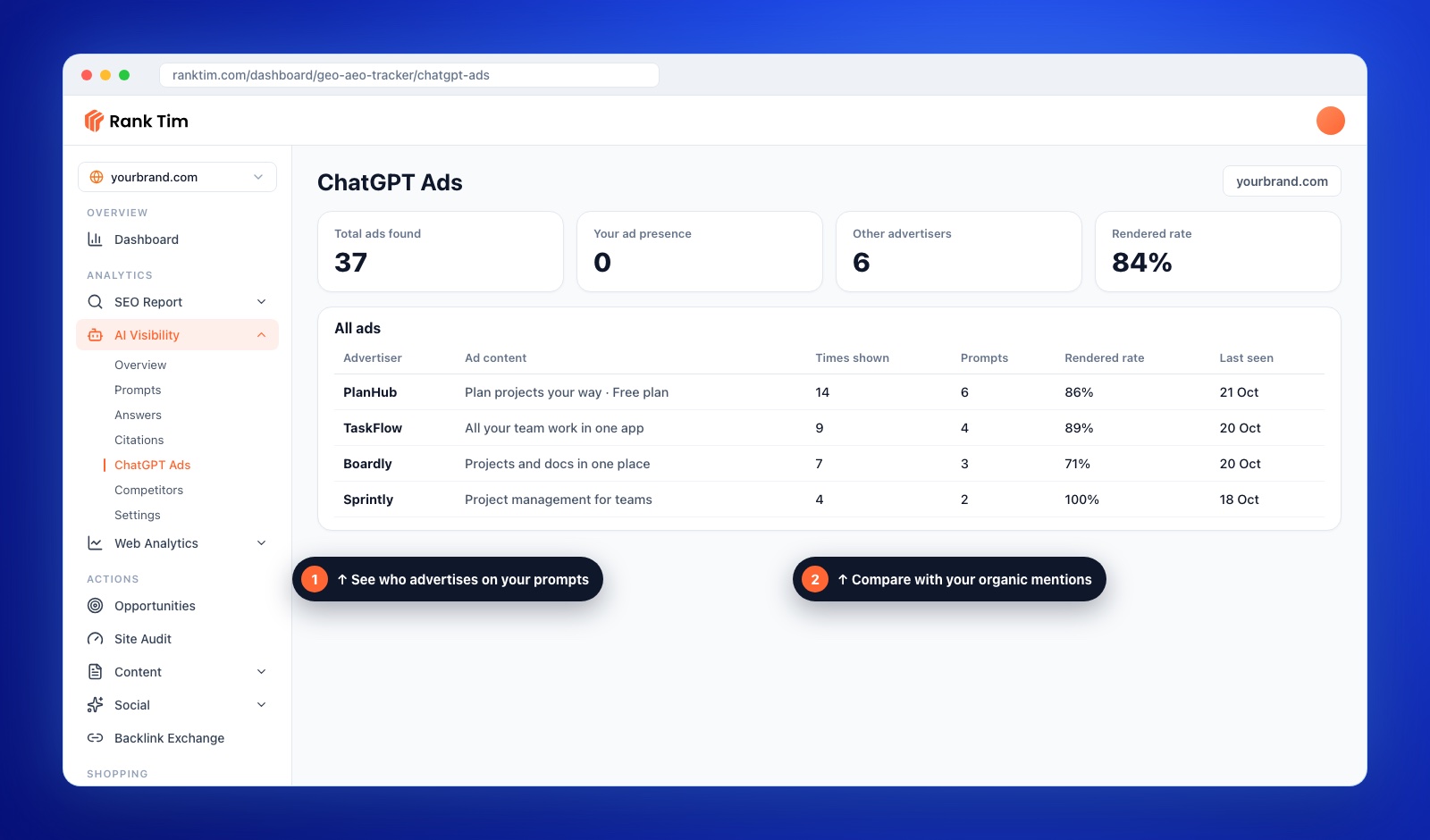
Next, find out whether your prompts carry ads and who's buying them. In RankTim, open AI Visibility → ChatGPT Ads. For the prompts you track in ChatGPT, it shows:
- Total ads found: how many sponsored placements appeared next to the answers.
- Your ad presence: how many of them were yours.
- Other advertisers: how many different brands advertised on your prompts.
- Rendered rate: the share of detected placements that were actually displayed.
- All ads: each advertiser with the ad content, times shown, number of prompts and when it was last seen.
Step 3: Compare Paid Placements With Organic Mentions
Put the two views side by side. For each important prompt, note whether you're mentioned in the answer, whether your pages are cited and whether competitors advertise below it. The Answers and Citations views in RankTim show the organic side. Four situations usually appear:
| Your organic visibility | Competitor ads | What to do |
|---|---|---|
| Strong | None | Protect it: keep pages fresh and sources current |
| Strong | Present | Watch closely; consider ads only if conversions drop |
| Weak | None | Fix organic visibility first; it's an open field |
| Weak | Present | Fix organic and consider a small ad test on high-intent prompts |
See who advertises on the prompts your buyers ask
RankTim's ChatGPT Ads view records the sponsored placements that appear next to ChatGPT answers for your tracked prompts: which advertisers show up, how often, for which prompts and whether you're among them.
Start Your Free TrialStep 4: Close Organic Gaps First
Ads won't change what ChatGPT says about you. If you're missing from the answer, the fixes are the same as for any AI visibility problem:
- Make your positioning clear on your own site: who you're for, what you do best and how you compare. Our guide to comparison and alternatives pages helps here.
- Correct what AI gets wrong about your brand. See how to fix what AI says about your brand.
- Get into the sources AI cites, from review sites to industry articles and communities.
- Publish something worth citing, like original data or a definitive guide.
Step 5: If You Test Ads, Test Them Properly
If ads make sense for some prompts, run them as an experiment, not a leap of faith:
- Check availability for your country and business in OpenAI's Ads Manager before planning a budget.
- Start narrow: a few high-intent topics where competitors already advertise or where you're new to the market.
- Match the conversation. People see your ad right after a detailed answer, so the message and landing page should continue that conversation, not repeat a generic slogan.
- Measure incrementally: compare sign-ups or leads from ChatGPT traffic before and during the test, and track it in GA4. Our GA4 guide for LLM traffic shows how.
- Don't expect ads to improve organic answers. By OpenAI's own rules, they don't.
Step 6: Track Both Over Time
Review organic and paid visibility together every month: mention rate, citations, sentiment, your ad presence and the number of competitors advertising on your prompts. A rising number of advertisers on your category's prompts is a signal that the space is getting more competitive, and that earning the organic answer is worth even more.
Common Mistakes to Avoid
- Assuming ads buy recommendations. They appear below the answer and don't change it.
- Ignoring competitors' ads. They show you which prompts others consider valuable.
- Pausing organic work for ads. Paid users and many contexts never see ads at all.
- Judging ads on one week of data. Placements vary by user, plan, country and conversation.
- Using the same ad copy as on search or social. The context is a conversation, not a keyword.
FAQ
Do ads influence what ChatGPT recommends?
According to OpenAI, no. Ads are separate from the answer, clearly labeled, and answers are optimized for what's most helpful to the user.
Who sees ads in ChatGPT?
Logged-in adult users on the Free and Go plans, in the countries where ads are available. Plus, Pro, Business, Enterprise and Edu plans don't show ads, and neither do Temporary Chats.
Can I advertise in ChatGPT from my country?
It depends on where your business is based. OpenAI has expanded ads and its self-serve Ads Manager to more countries during 2026, so check the current availability on OpenAI's advertiser pages.
Should small businesses advertise in ChatGPT?
Start by checking whether your prompts carry ads at all and how visible you are organically. If you're already recommended, ads may add little. If competitors dominate both the answer and the ads, a small, well-measured test can make sense.
How do I know if competitors advertise on my prompts?
Run your prompts in ChatGPT regularly and note the sponsored placements, or use a tool that records them automatically. RankTim's ChatGPT Ads view lists advertisers, ad content, prompts and how often each ad appeared.
Ads in ChatGPT add a paid lane next to AI answers, but the answer itself is still earned. Measure both, fix your organic visibility first and use ads where the data says they're worth it.
Measure Earned and Paid Visibility in ChatGPT
Track your organic mentions and citations across AI assistants, see which competitors advertise on your prompts and decide where to invest with real data.
Start for Free
Catalin Dinca
Written by Catalin Dinca