

Google Just Called Search "One Product." Here's What Changes for SEO and GEO
 Catalin Dinca
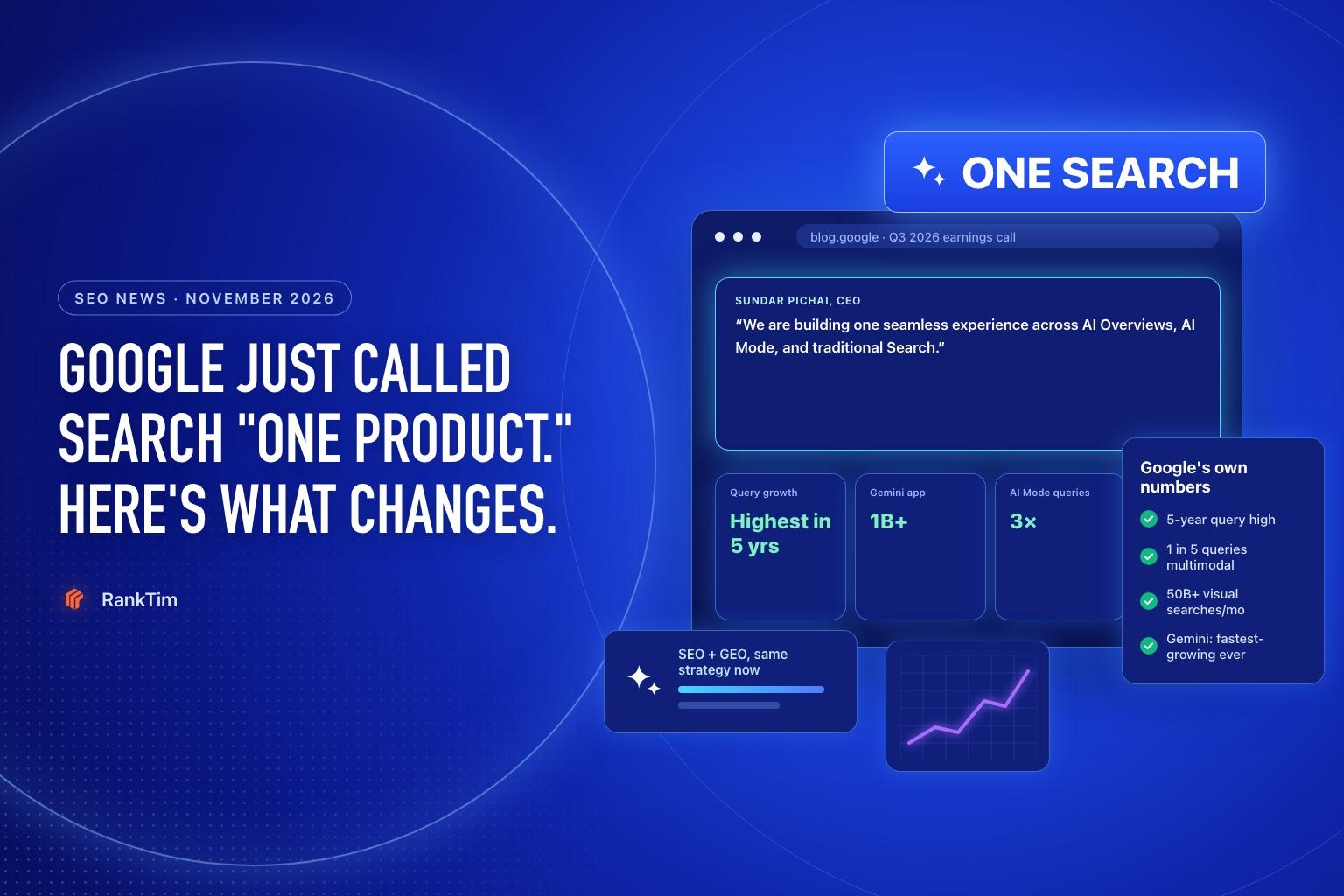
Every quarter, Google's earnings call is mostly a formality for SEOs: revenue numbers, a line or two about Search, nothing that changes what you do on Monday morning. The Q3 2026 call, held on October 28, was different.
In his prepared remarks, CEO Sundar Pichai described Google's direction for Search in a single sentence: "We are building one seamless experience across AI Overviews, AI Mode, and traditional Search." Not three products competing for attention. One experience, three surfaces, pulling from the same underlying systems.
For anyone who has spent the past two years treating "ranking in Google" and "getting cited by AI Overviews" as separate jobs, that's the clearest signal yet that the distinction is dissolving. Here's what Google said, what the numbers show, and what it actually means for your SEO and GEO work.
What Pichai Actually Said
Beyond the "one seamless experience" line, the call included numbers that explain why Google is framing Search this way:
- "Our year-over-year query growth rate is the highest it's been in the last five years." Pichai attributed this directly to AI: "Our AI investments are driving increased usage and overall query growth, including commercial queries."
- "Queries in AI Mode are on average three times longer than traditional searches, and one in five AI Mode searches globally use voice, images, or documents." People aren't typing two or three keywords anymore; they're describing what they actually want, often with a photo or a file attached.
- Google has "crossed over 50 billion visual searches per month."
- The Gemini app has reached 1 billion users, which Pichai called "the fastest-growing product in Google's history."
Put together, these numbers describe a search engine whose core input is changing shape. The box still says "Search," but what people type, speak or drop into it looks less like a keyword query every quarter.
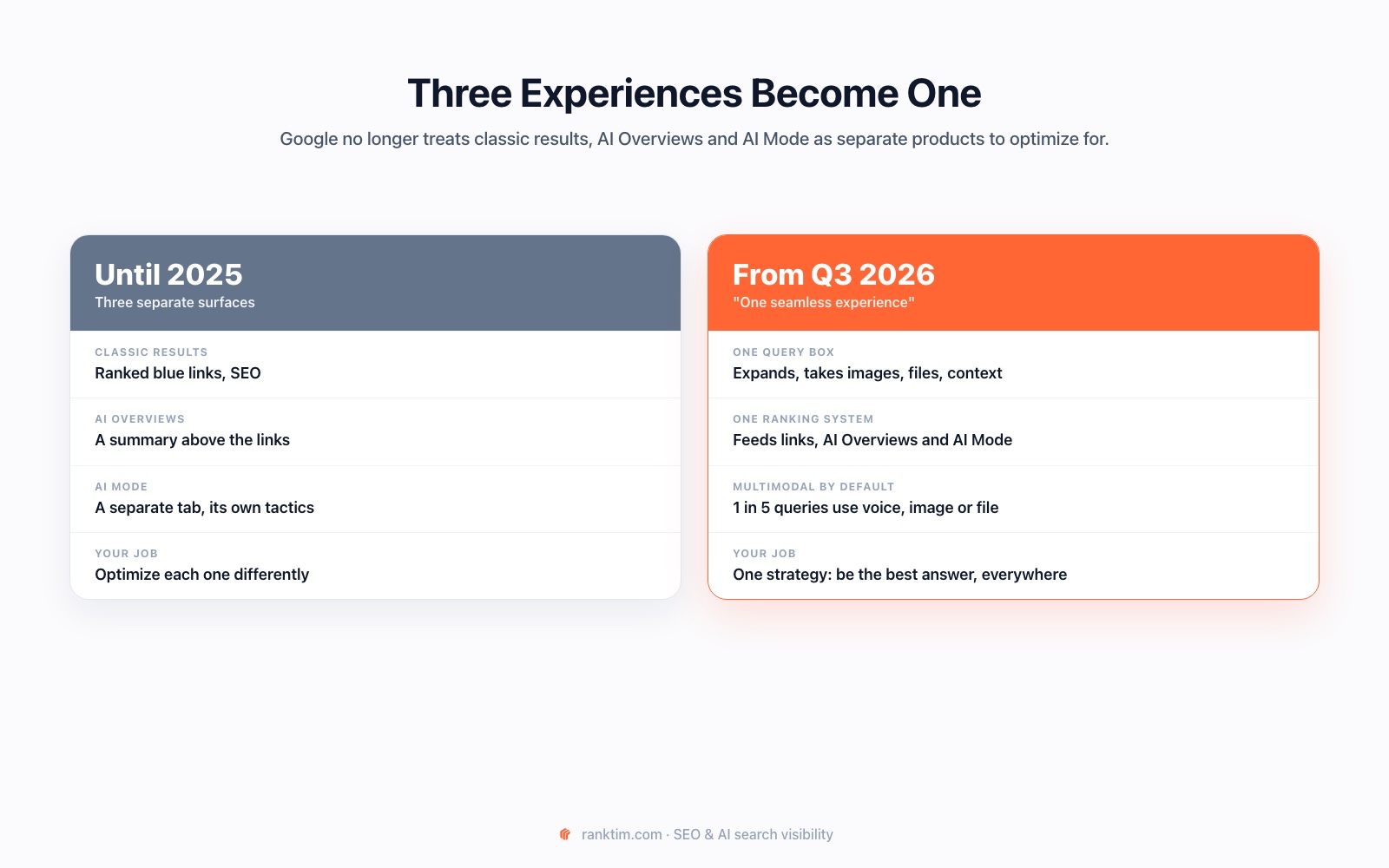
Why "One Product" Matters More Than It Sounds
It would be easy to read "one seamless experience" as marketing language and move on. A few reasons not to:
- It confirms what the ranking plumbing already suggested. Google's own documentation states that AI Overviews and AI Mode draw on the same eligibility rules as classic Search: a page needs to be indexed and eligible to appear with a snippet, nothing more. Our guide on getting cited in AI Overviews and AI Mode covers the mechanics. Pichai's framing is Google saying out loud what the technical reality already was.
- It's a statement about priorities, not just architecture. A company doesn't call something "one product" by accident on an earnings call. It tells investors, and indirectly the market, where engineering effort and ranking research are going: into a unified system, not into AI Overviews as a bolt-on experiment.
- It explains the growth numbers. If AI features were cannibalizing classic Search, you'd expect query growth to be flat or declining as people get faster answers and stop searching. Instead Google reports the opposite: a five-year high, driven specifically by AI usage. More natural-language, more exploratory, more multimodal queries are adding to search volume, not replacing it.
What Isn't Changing
It's worth being precise about what Google did and didn't say, because the headline version of this story tends to drift into "Google is replacing search with AI" takes that go further than the evidence supports.
- Google did not say AI Mode is replacing classic results. A separate view of results still exists alongside AI Mode for people who want it.
- Google did not announce new technical requirements, special markup, or an "AI SEO" checklist. Its own guidance is explicit that no special schema or AI-specific file is needed to appear in AI features.
- Pichai's framing is about user experience and engineering direction, not a one-time product switch that happens on a specific date. The merge is a description of where Google already is, more than an announcement of something new launching next week.
What Actually Changes for Your Strategy
| Old mental model | What to do instead |
|---|---|
| Optimize for keywords, then separately "optimize for AI" | Optimize for the question, in whatever form it arrives: typed, spoken, photographed, or pasted as a document |
| Track rankings, then separately track AI mentions | Track both from the same report, since they come from the same underlying system |
| Write for a 10-blue-links result page | Write so a 3x-longer, often multimodal query can be answered directly from your page |
| GEO is a side project for "the AI stuff" | GEO is what SEO looks like when the ranking system also writes answers |
1. Stop running separate SEO and GEO checklists
If one system now ranks your pages for classic results, AI Overviews and AI Mode, maintaining two different task lists, one for "SEO" and one for "GEO," creates duplicate work for no benefit. Merge them. Our GEO guide and query fan-out guide both describe the same underlying skill: answering the real question clearly, with facts a system can quote.
2. Take multimodal input seriously
One in five AI Mode queries globally now include voice, an image or a document, and Google is processing over 50 billion visual searches a month. If someone can photograph your competitor's product and ask "what's a cheaper alternative to this?", your pages need enough structured, specific detail, product names, materials, prices, compatible uses, for an AI system to connect that image to your answer. Vague marketing copy doesn't translate well into a visual match.
3. Write for longer, more specific questions
Queries that are three times longer aren't just "more keywords." They carry constraints: budget, location, use case, comparison targets. A page that answers "best waterproof hiking boots" in the abstract loses to one that can also answer "best waterproof hiking boots under $150 for wide feet on rocky trails." Build content around the real constraints your customers mention, not the shortest version of the question.
4. Measure across surfaces, not in silos
With one ranking system behind classic results, AI Overviews and AI Mode, your reporting should reflect that. In Rank Tim, AI Visibility → Overview shows your mention rate, ranking and sentiment broken down per model, including Google AI, next to ChatGPT, Gemini, Perplexity and Copilot, so a change to your content shows up in one view instead of three separate tools.
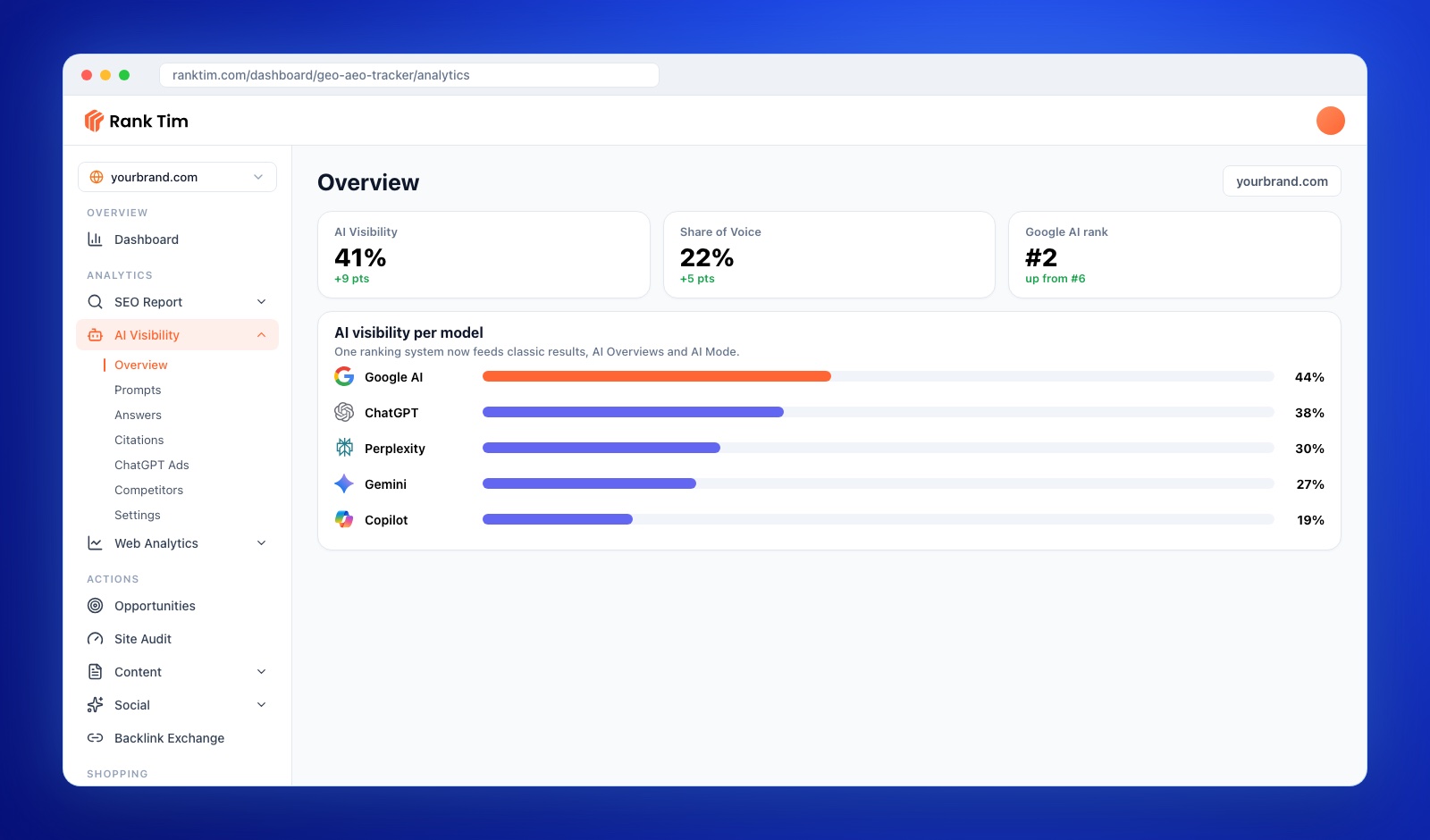
See your visibility across every Google surface, in one place
Rank Tim tracks your brand in Google AI Mode alongside ChatGPT, Gemini, Perplexity and Copilot, so you don't need a separate dashboard for "classic SEO" and "AI visibility" anymore.
Start Your Free TrialA Simple Checklist for the Shift
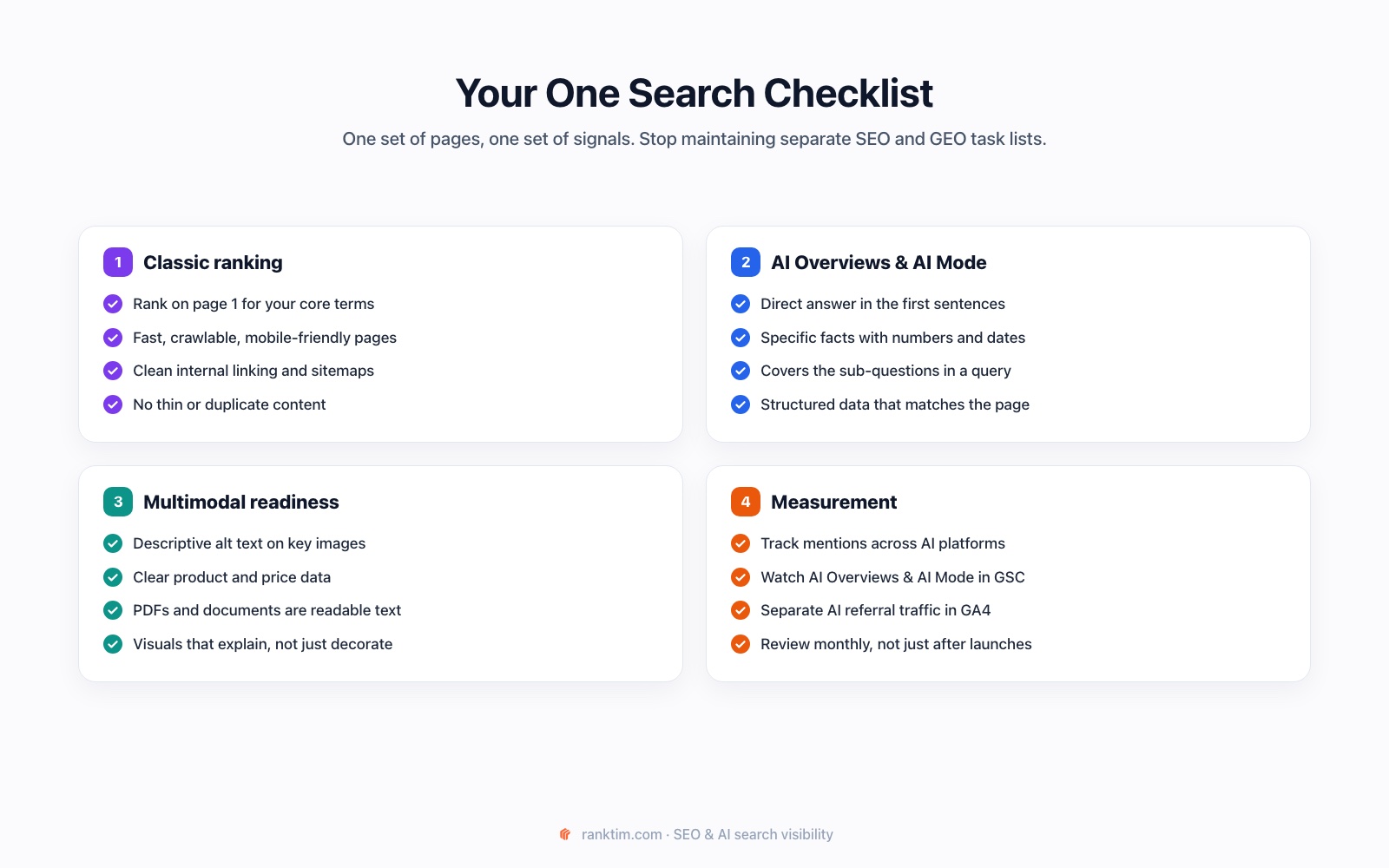
You don't need a new strategy from scratch. You need to stop treating the pieces you already have as separate:
- Classic ranking fundamentals still gate everything else: indexability, page speed, internal links, no thin or duplicate content.
- AI Overviews and AI Mode readiness means answering clearly in the first sentences, with specific facts and matching structured data. Our AI search optimization guide covers this in depth.
- Multimodal readiness means descriptive alt text, clear product and price data, and documents that are readable as text, not locked inside an image or a scan.
- Cross-surface measurement means tracking mentions, citations and rankings together, monthly, not reacting only after a visible drop.
FAQ
Did Google actually merge AI Overviews, AI Mode and classic search into one product?
Google's CEO described them as "one seamless experience" on the Q3 2026 earnings call, reflecting how the underlying ranking and eligibility systems already work. It's a statement about direction and architecture, not an announcement of a new, separately named product.
Does this mean classic SEO doesn't matter anymore?
No. Pages still need to be indexed and eligible to appear in Search before they can show up anywhere, including AI Overviews and AI Mode. The fundamentals of technical SEO and useful content remain the foundation; they now feed more surfaces at once instead of just one.
Why did Google's query growth hit a five-year high?
Google attributes it to AI-driven usage: people asking longer, more specific, more multimodal questions than they used to type as short keywords. More ways to search are adding query volume rather than replacing it.
Should I create separate content for AI Mode versus classic search?
No. Since one system now serves both, content built to clearly answer a specific question, with facts a system can quote and structure a reader can scan, works across classic results, AI Overviews and AI Mode without duplication.
What does "three times longer queries" mean for how I write content?
It means people are including more context, like budget, use case and comparison targets, in what they ask. Content that addresses those real constraints, rather than the shortest possible version of a keyword, is more likely to match what people are actually asking.
How do I track performance across all these surfaces at once?
Combine Search Console's Generative AI performance report for AI Overviews and AI Mode impressions with an AI visibility tool that tracks mentions and citations across ChatGPT, Gemini, Perplexity and Google AI. Our guide on measuring AI search visibility walks through the full setup.
Google didn't announce a new ranking factor or a checklist to follow. It confirmed, in plain language, that the split between "optimizing for Google" and "optimizing for AI" was already artificial. Treat your site that way, and the next quarterly earnings call will have a lot less to change.
One Strategy for One Search
Track your brand across Google AI Mode, AI Overviews, ChatGPT, Gemini, Perplexity and Copilot, audit your site for AI readiness and measure what actually changes after you publish.
Start for Free
Catalin Dinca
Written by Catalin Dinca