

GEO and AEO Trends for Black Friday 2026
 Catalin Dinca
Black Friday is November 27. As of today, that's 20 days out, and the way shoppers find deals through AI has changed meaningfully since last year. Google now describes classic results, AI Overviews and AI Mode as one ranking system. Agentic checkout, letting an AI assistant complete a purchase, is live on some platforms and paused on others. And AI Mode is still choosing not to show most products it technically has access to.
None of these are hypothetical "AI is changing everything" predictions. They're confirmed shifts, from earnings calls, platform documentation and independent research, that change what's worth doing in the next three weeks. Here are seven GEO and AEO trends shaping this Black Friday, and the specific action each one points to.
TL;DR
- Search is one ranking system now. Google describes classic results, AI Overviews and AI Mode as "one seamless experience," so there's no separate "AI strategy" to run alongside SEO anymore.
- AI Mode still shows far fewer products than classic search, roughly 95% fewer in one study, often at higher prices than your actual feed.
- Agentic checkout is live at Google, paused at OpenAI and in testing at Microsoft. Know which one actually matters for your store before building around any of them.
- Dated, specific evidence is becoming the standard format for content AI cites, replacing generic claims with facts stamped to a date.
- Long, specific holiday queries fan out into sub-questions your content needs to answer directly, not just the headline topic.
- Community threads and review sites increasingly feed AI shopping answers, which means your reputation there matters as much as your own site.
- Measurement has finally caught up, with first-party tools now showing AI impressions, citations and referral traffic instead of leaving you guessing.
Table of Contents
- Trend 1: Search, AI Overviews and AI Mode Are Now One Ranking System
- Trend 2: AI Mode Still Shows Far Fewer Products Than Classic Search
- Trend 3: Agentic Checkout Is Arriving, Unevenly
- Trend 4: Gift Guides With Dated, Verifiable Evidence Are Becoming the Standard
- Trend 5: Query Fan-Out Is Turning "Best Gifts for X" Into Dozens of Sub-Questions
- Trend 6: Community and Review Sources Carry More Weight in AI Shopping Answers
- Trend 7: Measurement Is Finally Catching Up
- This Season's Shift, at a Glance
- Frequently Asked Questions
- Sources and Further Reading
Trend 1: Search, AI Overviews and AI Mode Are Now One Ranking System
On Google's Q3 2026 earnings call, CEO Sundar Pichai described the direction plainly: "We are building one seamless experience across AI Overviews, AI Mode, and traditional Search." Not three products to optimize separately, one system feeding three surfaces.
For Black Friday specifically, this settles a question a lot of e-commerce teams were still asking: do we need a separate "AI strategy" for the holidays on top of our normal SEO push? The answer is no. A page that's indexed, fast and answers the question clearly feeds classic rankings, AI Overviews and AI Mode at the same time. Our deeper look at what Google's unified search means for SEO and GEO covers the full shift; the short version for this season is: stop running two task lists.
Trend 2: AI Mode Still Shows Far Fewer Products Than Classic Search
A study tracking over 100,000 identical shopping searches found Google AI Mode shows at least one product in only about 23% of shopping queries, versus roughly 88% for classic search, and when it does show a product, the price often runs about 21.6% higher than the same item in regular results that same day.
This gap hasn't closed heading into Black Friday. If anything, it raises the stakes: the channel growing fastest in holiday referral traffic (Adobe projects AI traffic to retail sites up 130% this season) is also the one where most products are statistically likely to be invisible or mispriced. Our holiday shopping GEO guide walks through the four-week fix; the trend to watch is that this isn't a bug that's quietly getting patched, it's a structural feature of how AI Mode selects a handful of answers instead of a full results grid.
Trend 3: Agentic Checkout Is Arriving, Unevenly
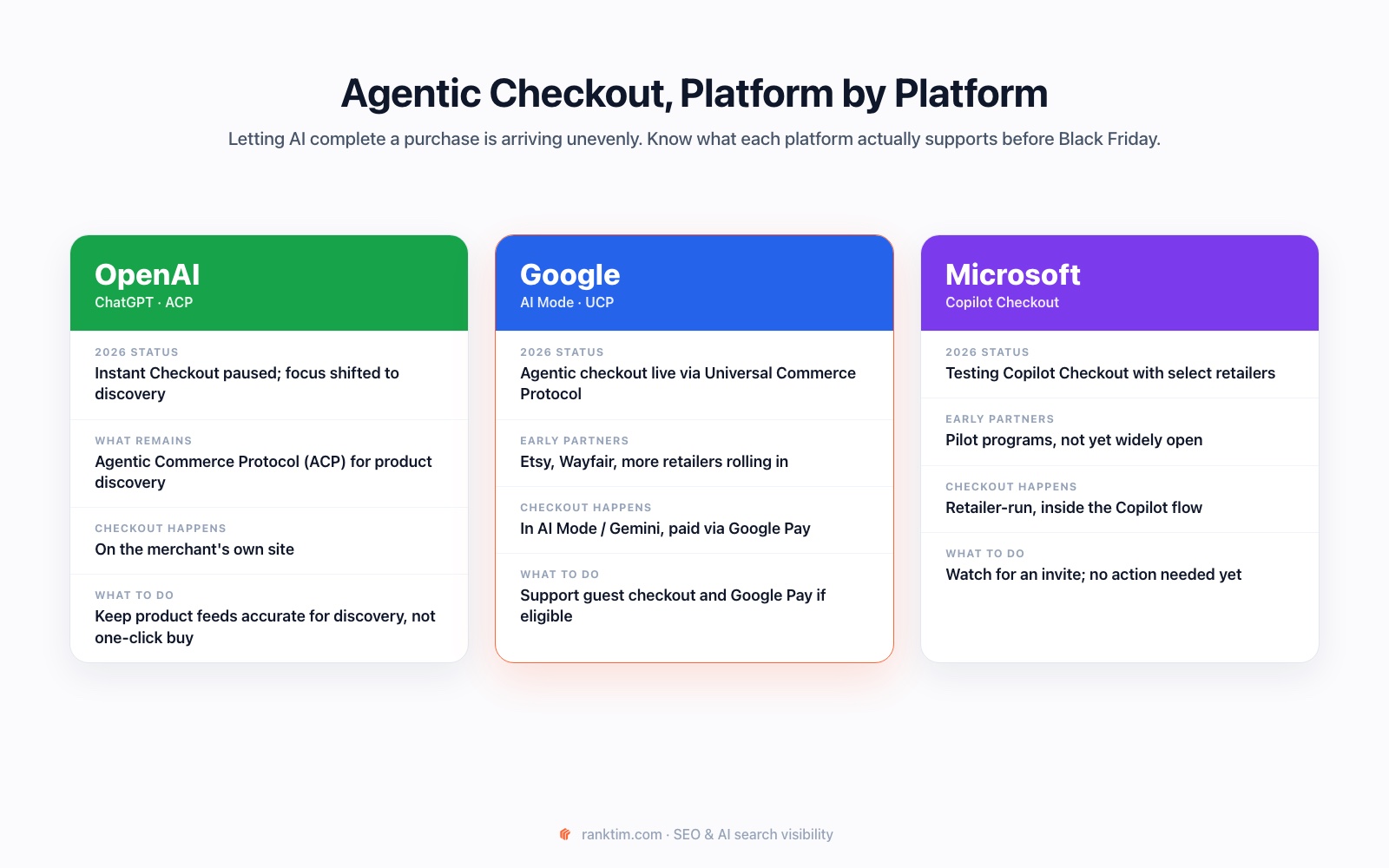
This is the newest shift worth tracking. "Agentic checkout," letting an AI assistant complete a purchase instead of just recommending a product, moved in different directions at each major platform this year.
| Platform | Where it stands | What matters for your store |
|---|---|---|
| OpenAI / ChatGPT | Instant Checkout paused after weak uptake; the Agentic Commerce Protocol (ACP) remains, now focused on product discovery rather than one-click buying | Keep product data accurate for discovery; don't build for a one-click buy button that isn't currently the priority |
| Google / AI Mode & Gemini | Agentic checkout is live via the Universal Commerce Protocol (UCP), with early partners including Etsy and Wayfair, and more merchants expected to roll in | If you're Shopify-based or support guest checkout and Google Pay, check your eligibility now, not after Black Friday |
| Microsoft / Copilot | Testing Copilot Checkout with select retailers in pilot programs, not yet broadly available | Nothing to build yet; worth watching for an invitation, not worth prioritizing this season |
See how AI describes your store right now
Rank Tim runs the real shopping questions your customers ask in ChatGPT, Google AI, Gemini and Perplexity, then shows which products, pages and competitors get cited.
Get a Free AI Visibility AuditTrend 4: Gift Guides With Dated, Verifiable Evidence Are Becoming the Standard
A pattern showing up across recent GEO guidance: content built around specific, dated facts outperforms content built around general claims. Instead of "this is a great gift under $50," the format that earns citations looks like "Price checked: $39 on November 6, 2026."
This matters more during Black Friday than any other season, because prices genuinely change daily and AI assistants have no way to verify a claim that doesn't carry a date. Our guide to creating gift guides AI engines recommend covers the full format: who a product suits, why it was selected, its limitation, and current commercial details, verified and dated, not assumed.
Trend 5: Query Fan-Out Is Turning "Best Gifts for X" Into Dozens of Sub-Questions
Google's AI Mode doesn't just answer "best gifts for coffee lovers" as a single query. It breaks that into related sub-searches: budget ranges, specific product types, comparisons, occasion-specific variants, then builds an answer from whichever pages win each piece.
For holiday content specifically, that means a single gift guide needs to anticipate a wider spread of real questions than it used to: "under $30," "for someone who already has everything," "that ships by December 20." Our query fan-out guide explains the mechanism in full; the seasonal version is simply that your holiday content now competes on more fronts than the headline keyword suggests.
Trend 6: Community and Review Sources Carry More Weight in AI Shopping Answers
Reddit threads, forum discussions and independent review sites increasingly show up as sources behind AI shopping recommendations, sometimes more consistently than retailer pages themselves. For Black Friday specifically, deal-community sites and review outlets tend to rank and get cited early, often before retailers' own seasonal pages are live.
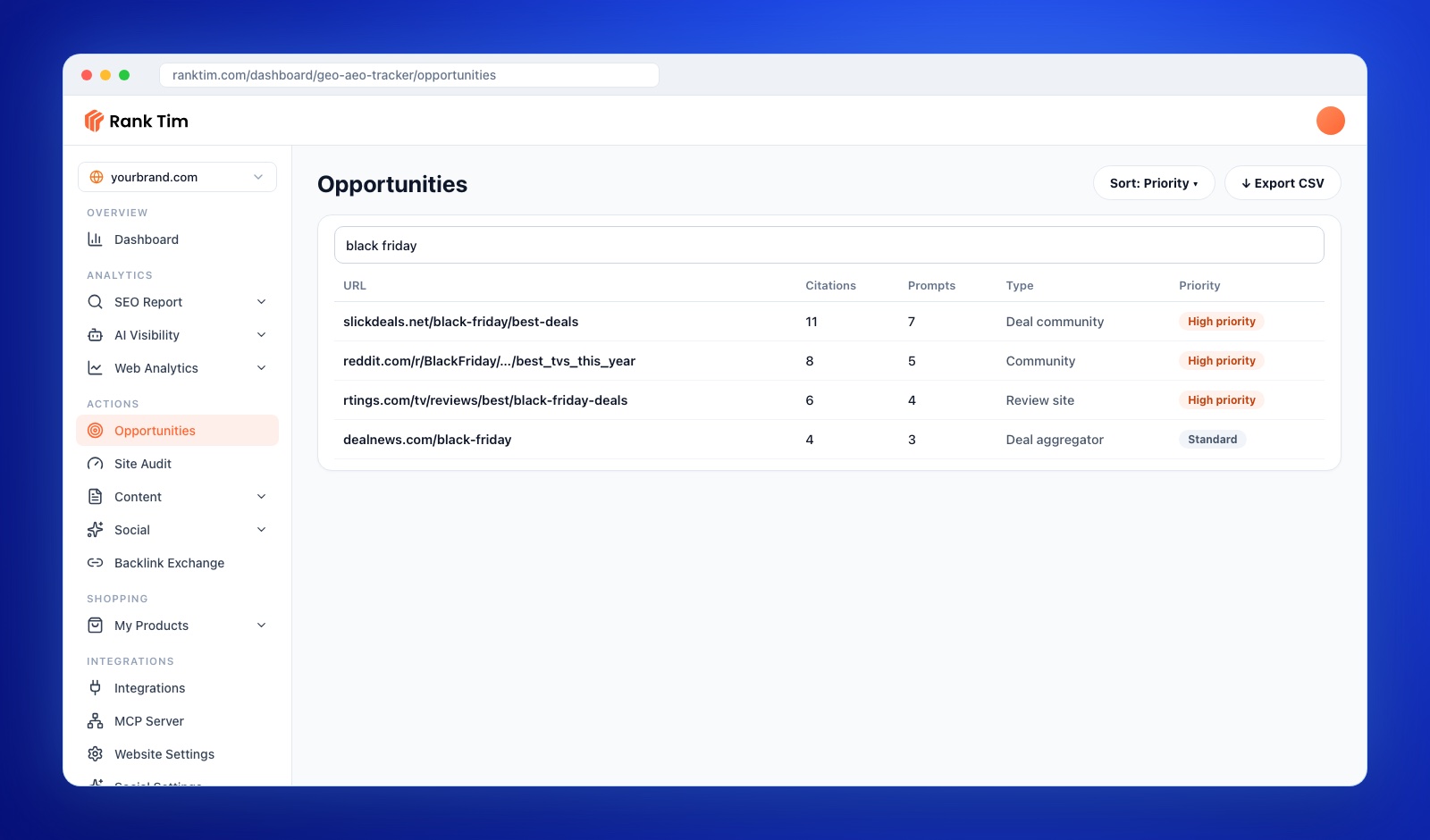
Tracking which community and review sources already get cited for your category tells you where to focus outreach, and where your own content is competing against sources you don't control. Our guide to using Reddit and communities for AI visibility covers how to participate without it reading as spam.
Trend 7: Measurement Is Finally Catching Up
For most of the past two years, "AI search" had almost no first-party measurement. That changed meaningfully in 2026. Search Console now has a Generative AI performance report showing impressions in AI Overviews and AI Mode. Bing Webmaster Tools added an AI Performance report showing citations in Copilot and Bing's AI summaries. GA4 added a dedicated AI Assistant channel for traffic from ChatGPT, Gemini, Copilot and others.
| Tool | Shows you |
|---|---|
| Search Console | Impressions in AI Overviews and AI Mode, by page, country and device |
| Bing Webmaster Tools | Citations in Copilot and Bing's AI summaries, plus sampled grounding queries |
| GA4 | Sessions and conversions from the AI Assistant channel, separated from classic organic traffic |
None of these replace tracking your actual prompts across ChatGPT, Google AI and Gemini directly, since they only show what each platform chooses to report. But combined, they close most of the gap that made "did AI search even work this season" impossible to answer a year ago. Our guide to measuring AI search visibility shows how to combine all three.
This Season's Shift, at a Glance
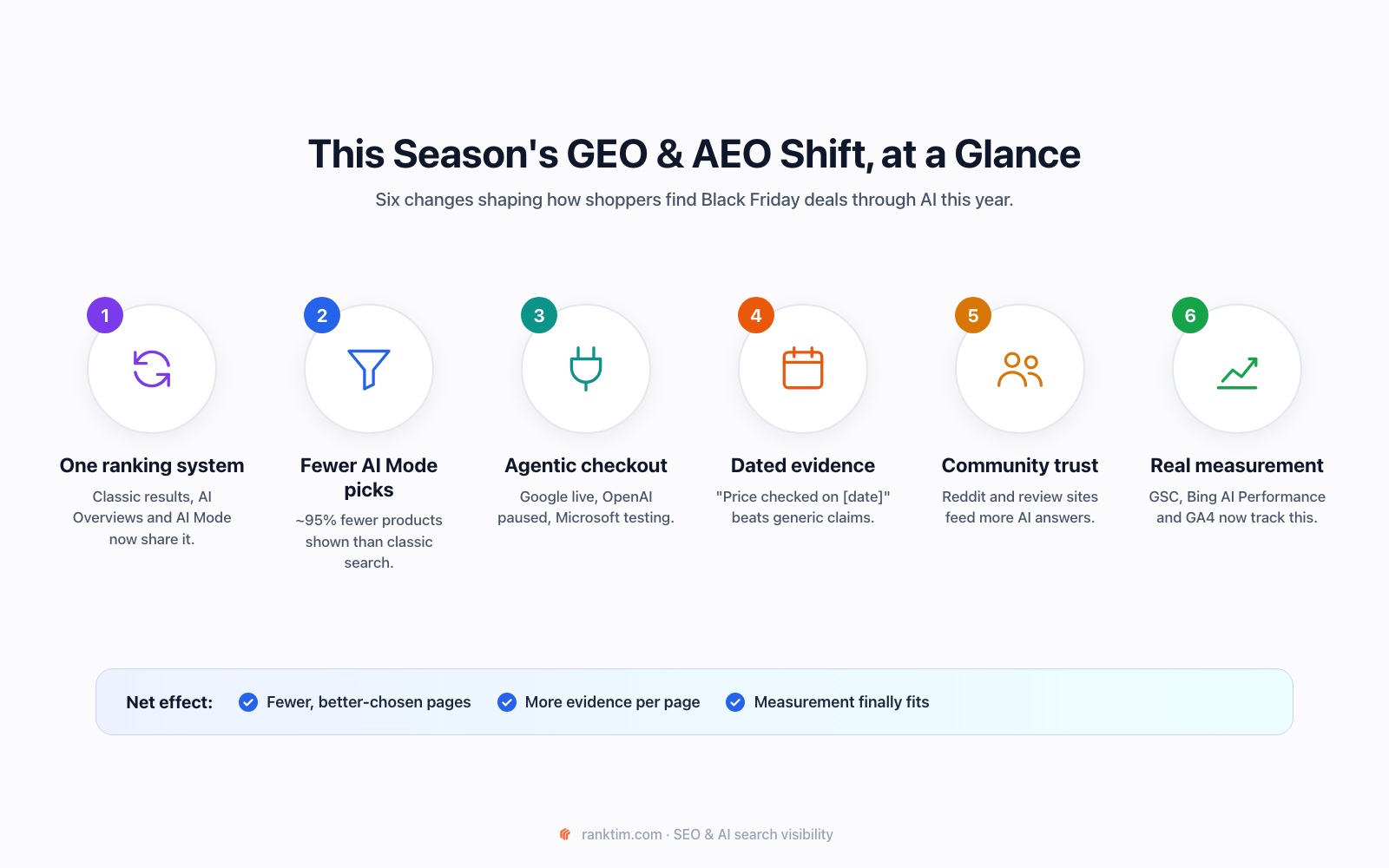
Taken together, these trends point to the same net effect: fewer pages are winning each query, but the ones that win are carrying more specific, dated, verifiable evidence than they used to need. The bar for "good enough" content dropped in volume and rose in precision.
Frequently Asked Questions
Do I need a separate AI strategy for Black Friday?
No. Google now treats classic results, AI Overviews and AI Mode as one ranking system, so the same technical and content fundamentals feed all three. A separate "AI checklist" running alongside your normal SEO work creates duplicate effort without a corresponding benefit.
Should I build for agentic checkout before Black Friday?
Only if you're eligible for Google's rollout via the Universal Commerce Protocol, which is the one platform with agentic checkout genuinely live this season. OpenAI paused its in-chat checkout, and Microsoft's is still in limited testing, so there's little to build for on those two yet.
Why does my store show up less in Google AI Mode than in regular search?
Independent research found AI Mode shows a product in only about 23% of shopping queries, versus roughly 88% for classic search, because it generates one focused answer rather than a full results grid. Most eligible products don't get selected even when the underlying feed data is correct.
What content format works best for holiday gift guides this year?
Specific, dated evidence: who a product suits, why it was chosen, its limitation, and a price or availability fact tied to a date, rather than general claims like "a great gift." This gives AI systems something concrete and verifiable to quote.
How do I measure whether my Black Friday content is working in AI search?
Combine Search Console's Generative AI performance report, Bing's AI Performance report in Webmaster Tools and GA4's AI Assistant channel for first-party data, and track your own tracked prompts across ChatGPT, Google AI and Gemini directly to see what those reports can't show on their own.
Sources and Further Reading
- Google: Q3 2026 earnings call remarks from the CEO
- OpenAI: Shopping with ChatGPT Search
- OpenAI Developers: Product feeds and Agentic Commerce
- Google Search Central: Product structured data
- Google Analytics Help: Default channel group
- Microsoft Bing: Introducing AI Performance in Bing Webmaster Tools
- Featured photograph: Vitaly Gariev on Unsplash, used under the Unsplash License and adapted to the Rank Tim visual style.
Turn Trends Into a Black Friday Plan
Plan content around buyer questions, publish it automatically and track whether your brand earns mentions across Google and AI search.
Start Free
Catalin Dinca
Written by Catalin Dinca