

Your Products Are Nearly Invisible in AI Mode This Holiday Season
 Catalin Dinca
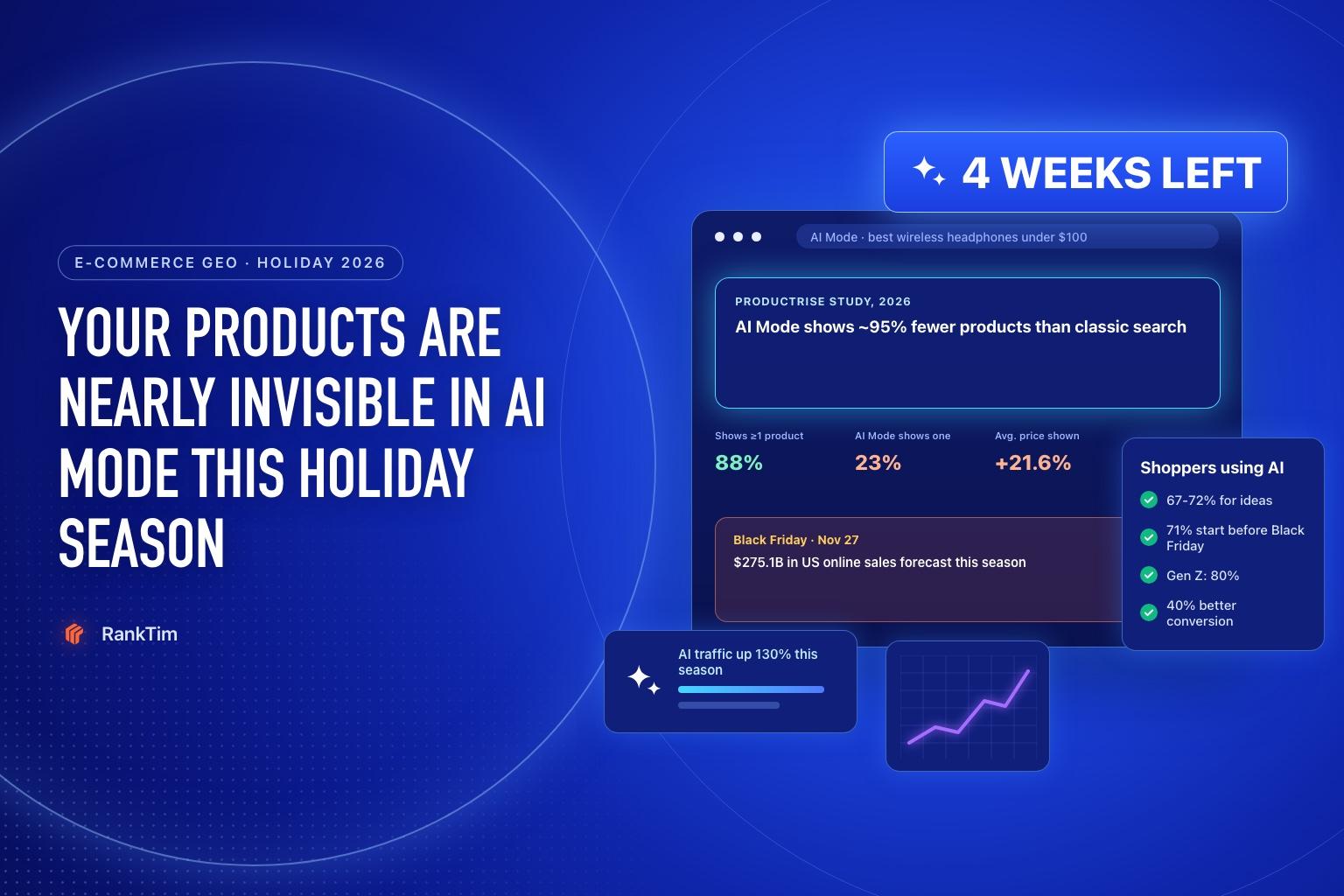
Black Friday is November 27. Cyber Monday is November 30. Adobe forecasts $275.1 billion in US online holiday sales this season, and a growing share of shoppers are starting that search in an AI assistant instead of a search bar.
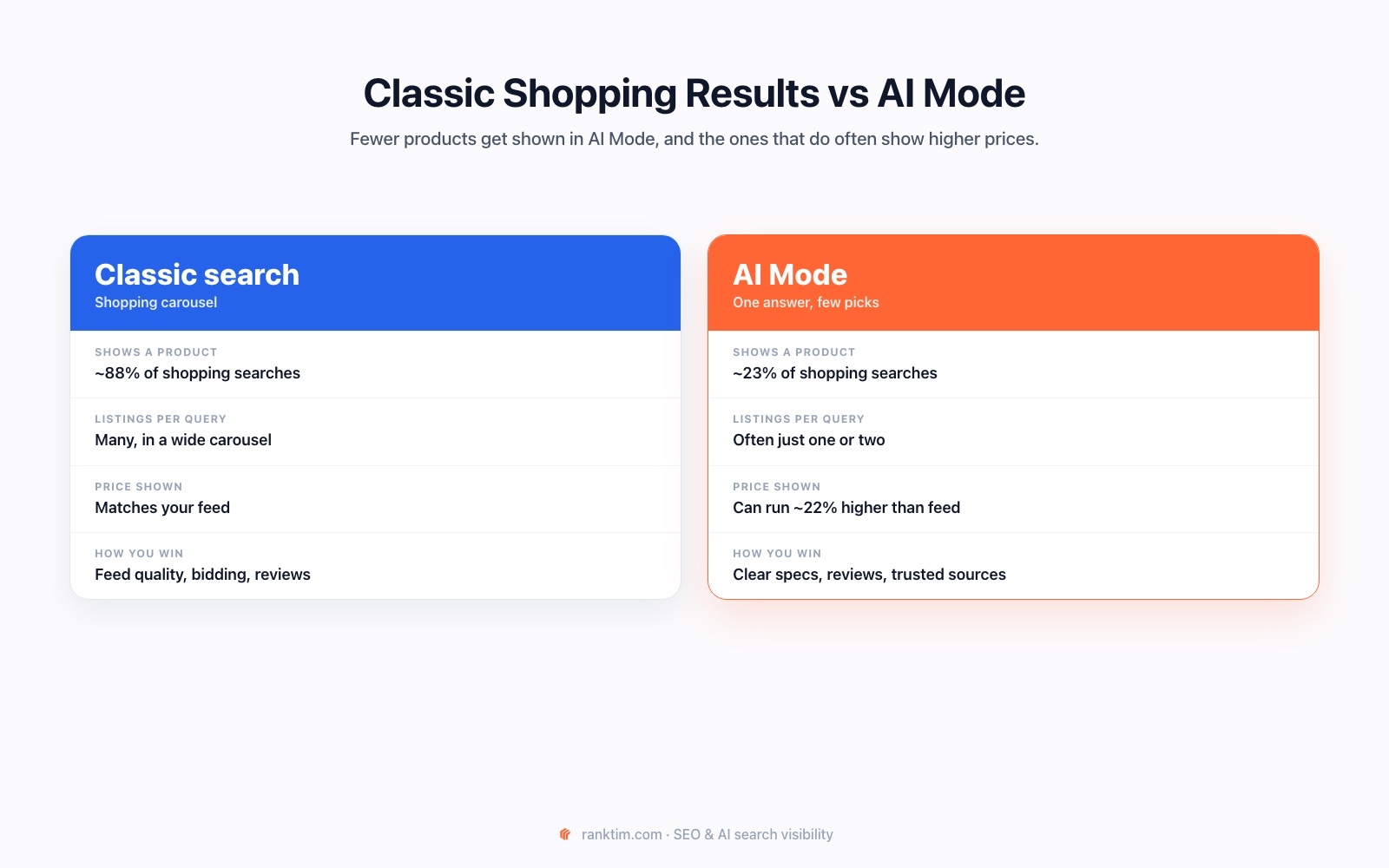
Here's the problem: a study of more than 100,000 identical shopping searches, tracked across three weeks in mid-2026, found that Google AI Mode shows at least one product in only about 23% of shopping queries, compared to roughly 88% for classic Google search. When AI Mode does show a product, the price attached to it runs about 21.6% higher on average than the same product's price in traditional search results on the same day.
Translation: the fastest-growing part of search is also the part where most products, including yours, are statistically likely to be missing or shown with the wrong price. With four weeks left before Black Friday, here's what's happening and what to fix first.
The Numbers Behind This Season
| What's happening | The number |
|---|---|
| US online holiday sales forecast (Nov 1 – Dec 31) | $275.1 billion, up 6.7% year over year (Adobe) |
| AI referral traffic to retail sites this season | Up 130% year over year (Adobe) |
| Consumers using AI tools for gift ideas or shopping | 67–72% in recent surveys (Attentive, Optimove) |
| Shoppers planning to start before Black Friday | 71% (Attentive) |
| Shopping queries where AI Mode shows a product | ~23%, vs ~88% in classic search (Productrise) |
| Average price difference when AI Mode does show one | +21.6% higher than the same product in classic search (Productrise) |
Two things are true at once this season: more shoppers than ever are turning to AI to research purchases, and AI Mode specifically is far more conservative about which products it surfaces than classic Google search is. That gap is where you either show up or you don't.
Why AI Mode Shows So Few Products
Google has told reporters it hasn't independently verified the specifics of the study, and says all shopping results, including AI Mode, draw on the same Google Shopping Graph data source as classic Shopping results. That consistency in data source is exactly why the gap matters: if AI Mode pulls from the same feed but surfaces so much less of it, something in how a product qualifies to be picked, not just listed, is working against most retailers by default.
A few likely reasons, based on how AI Mode is known to work:
- AI Mode answers one question, not a grid. Classic Shopping can show a dozen options side by side. An AI-generated answer has to choose a handful, or just one, to actually recommend, which means most eligible products never make the cut even if they're technically in the feed.
- Specificity probably wins the selection. A listing with precise, complete data, exact size, material, compatible use, current stock, is easier for a system to confidently recommend than one with vague or missing attributes.
- Price data can lag. If AI Mode pulls from a slightly different snapshot or cache of your feed than classic Shopping does, a recent price change or promotion may not be reflected yet, which could explain some of that 21.6% gap.
Your 4-Week Countdown to Black Friday
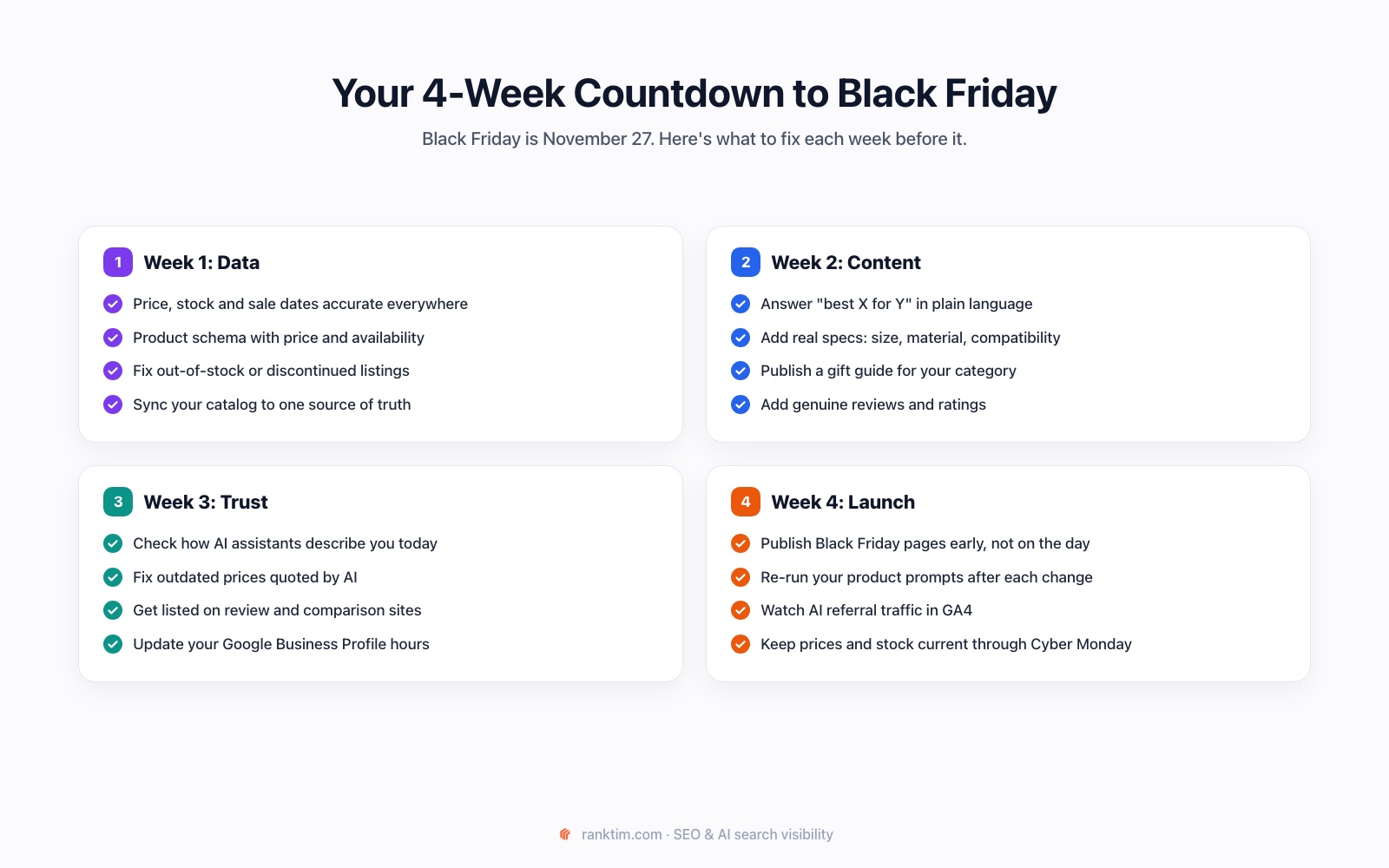
With Black Friday four weeks out, prioritize in this order. Each week builds on the last.
Week 1: Get the data right everywhere
- Make sure price, stock status and sale start/end dates are accurate on your site, your feed, and any marketplace listings, all at once.
- Add or check product structured data: price, currency, availability and condition, using Google's structured data guidelines.
- Remove or redirect out-of-stock and discontinued product pages rather than leaving them live with stale prices.
- If you sell on Shopify or another platform, sync your catalog from one source of truth instead of updating multiple places by hand.
Week 2: Make product pages answer the real question
- Answer "best [category] for [use case]" directly, in plain language, near the top of category and comparison pages.
- Add the specific details buyers actually search for: exact size, material, compatibility, battery life, whatever distinguishes your product from a near-identical one.
- Publish a short gift guide for your category if you don't have one; these pages tend to match exactly how people phrase AI Mode queries during the holidays.
- Make sure genuine reviews and ratings are visible on the page itself, not only on a separate tab.
Week 3: Build the trust signals AI checks
- Run your top 15–20 product and category prompts through ChatGPT, Google AI Mode and Gemini, and note exactly what price and description each one gives today.
- Fix any outdated price or feature AI assistants are currently repeating about you; it won't correct itself.
- Check that you're listed accurately on the review and comparison sites AI assistants tend to cite for your category.
- If you have a physical location, confirm your Google Business Profile hours and holiday schedule are current.
Week 4: Launch and watch it closely
- Publish Black Friday and holiday landing pages at least a few days before launch, not the morning of, so they have time to be crawled and indexed.
- Re-run your tracked prompts after each content or price change instead of waiting until after Black Friday to check.
- Watch AI referral traffic in GA4 alongside your usual channels; Adobe's 130% growth figure for the season suggests this channel is no longer a rounding error.
- Keep prices and stock current straight through Cyber Monday; this isn't a set-it-and-forget-it window.
See what AI says about your products right now
Rank Tim runs your real shopping prompts, like "best [product] under $[price]," across ChatGPT, Google AI Mode, Gemini and Perplexity, and shows whether you're mentioned, what price is quoted and which competitor wins instead.
Get a Free AI Visibility AuditFixing This Doesn't Replace the Fundamentals
If you haven't done the broader work of making your catalog AI-visible, the holiday season is the wrong time to start from zero, but the right time to prioritize ruthlessly. Our full e-commerce GEO guide covers the complete foundation: product schema, feed quality, buying guides and review systems. This piece is about what to triage in the next four weeks specifically, given what's measurably broken in AI Mode right now.
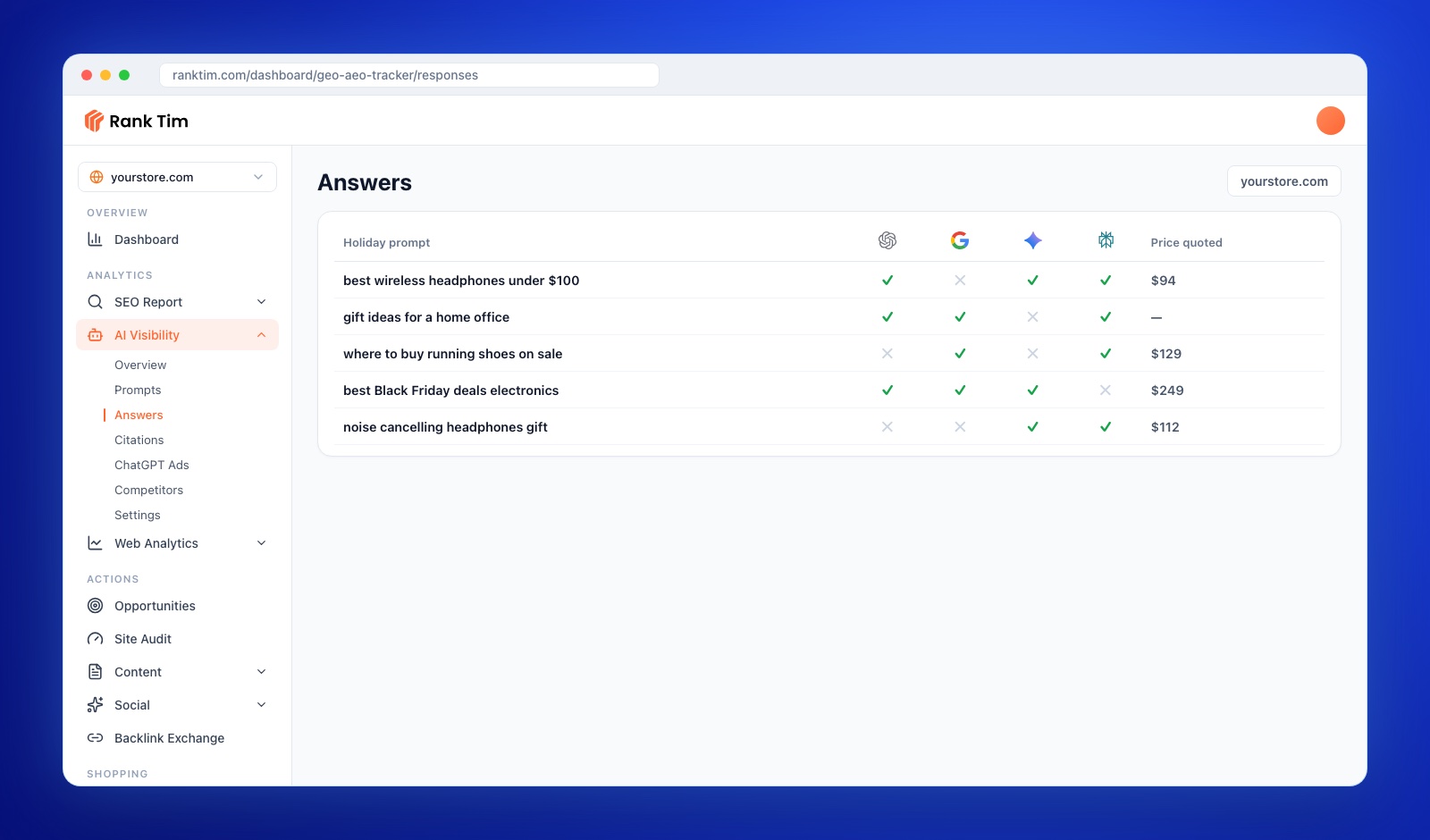
In Rank Tim, track your real holiday prompts, "best [product] under $[price]," "[category] gift ideas," "best Black Friday deals [category]," under AI Visibility → Answers, and sync your catalog under My Products so the data behind your pages stays current without manual updates across every channel.
FAQ
Why does Google AI Mode show fewer products than regular Google search?
Independent research found AI Mode surfaces roughly 95% fewer product listings than classic search, showing a product in about 23% of shopping queries versus roughly 88% for standard results. AI Mode generates a focused answer rather than a full results grid, so most eligible products in a feed don't get selected even when they technically qualify.
Are AI Mode prices actually different from Google Shopping?
A large-scale study found that when the same product appears in both AI Mode and classic search on the same day, the price shown in AI Mode is about 21.6% higher on average. Google has said all Shopping results, including AI Mode, use the same Shopping Graph data source, so check your feed's price freshness and caching if this affects you.
What should e-commerce sites fix first before Black Friday?
Start with data accuracy: correct prices, stock status and sale dates everywhere your products appear, plus complete structured data. Accurate, specific product information is the baseline every other fix depends on.
How much AI referral traffic should I expect this holiday season?
Adobe projects AI referral traffic to US retail sites will grow 130% year over year this season, with the sharpest spikes around Thanksgiving and Black Friday specifically. Treat it as a channel worth watching daily during the season, not a rounding error.
Should I create separate content for AI shopping assistants versus Google Shopping?
No. Both draw on the same underlying product data and index. Specific, accurate, well-structured product information helps you in classic Shopping results, Google AI Mode and chat-based assistants like ChatGPT and Gemini at the same time.
Is it too late to fix this before Black Friday?
No, but prioritize. Data accuracy, correct prices, in-stock status, complete schema, takes days to fix and has the most direct effect on being shown correctly at all. Content and trust-signal improvements matter too, but data accuracy comes first because everything else is built on top of it.
With four weeks until Black Friday and AI assistants already shaping how people shop, the products that get checked and corrected now are the ones that show up, with the right price, when it counts.
Don't Let AI Shoppers Miss Your Products
Track your products across AI assistants, catch outdated prices before customers do, and sync your catalog so every channel shows the same accurate data this holiday season.
Start for Free
Catalin Dinca
Written by Catalin Dinca