

How to Write an SEO Content Brief That Ranks and Gets Cited by AI (With Template)
 Catalin Dinca
When an article underperforms, the writing usually gets the blame. More often, the problem started earlier. The brief said "write 1,500 words about CRM pricing, keyword: crm pricing" and left everything else to chance: who the reader is, what they need to know first, what makes this page better than the ten already ranking.
A good content brief closes those gaps before writing starts. In 2026 it also has a second job: making sure the page is easy for AI assistants to understand, quote and cite.
This tutorial walks through every section of a brief that does both, and ends with a template you can copy.
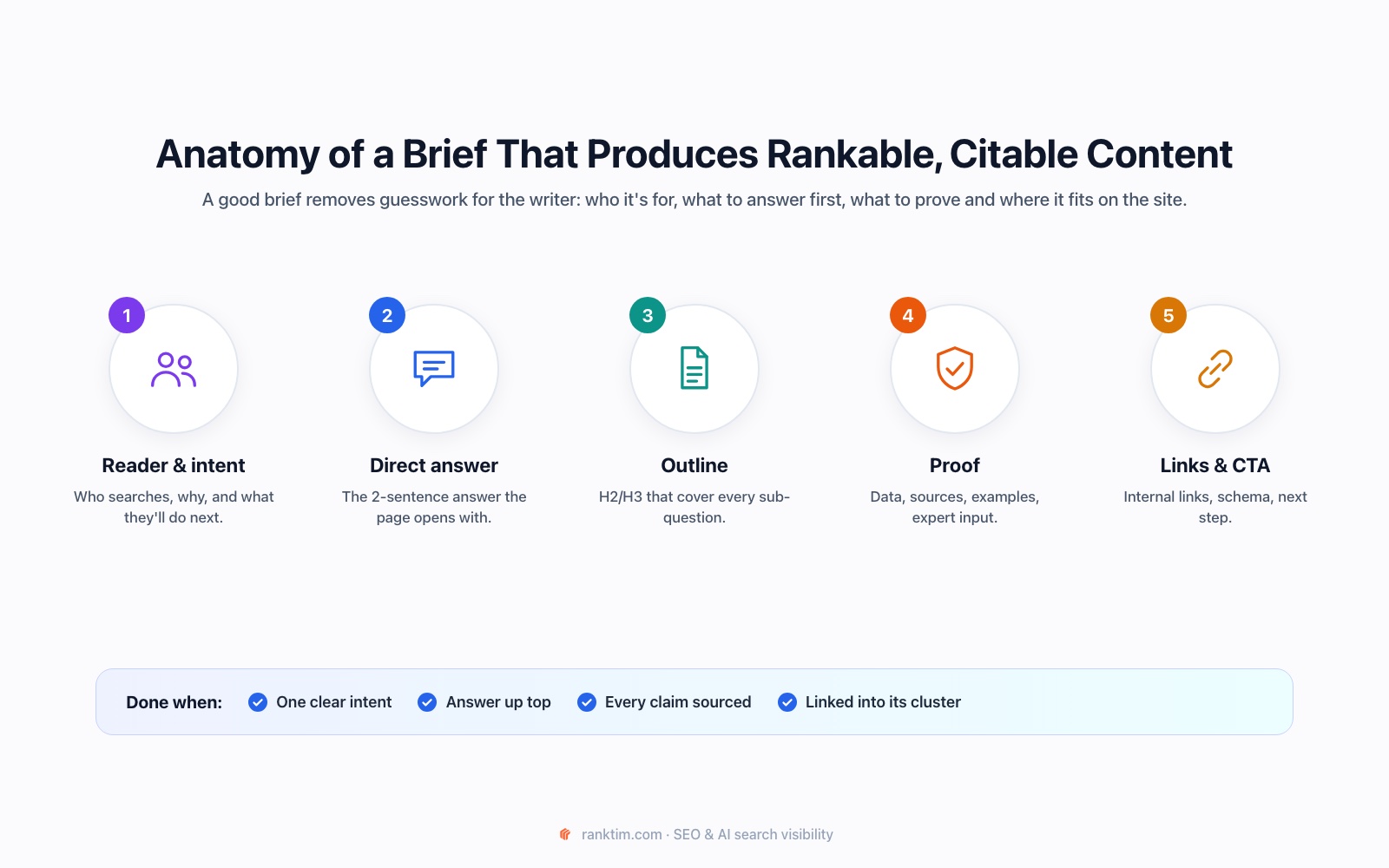
Section 1: Goal, Reader and Search Intent
Start with three sentences:
- Goal: what the page should achieve for the business. "Help small agencies compare CRM costs and start a trial."
- Reader: who is searching and what they already know. "An agency owner with 5 to 20 people, currently using spreadsheets, comparing first CRMs."
- Search intent: what they want from this search. Informational (learn), commercial (compare options), transactional (buy) or navigational (find a specific site).
Check intent against reality: search the main keyword and look at what ranks. If the top results are comparison tables and your plan is a long essay, the brief is wrong, not the search results.
Section 2: Keywords and Questions
- Primary keyword: the main query the page should rank for.
- Secondary keywords: close variations and related terms people use for the same need.
- Questions to answer: from People Also Ask, Search Console, sales calls and the prompts your buyers ask AI. Our prompt research tutorial shows how to collect them.
Keywords tell the writer which words to use. Questions tell them what to cover. The questions matter more.
Section 3: The Direct Answer
Write, in the brief itself, the one- or two-sentence answer the page should open with. For example:
Most CRMs for teams of 5 to 20 people cost between 15 and 50 EUR per user per month in 2026. The price depends mainly on automation limits, the number of contacts and whether reporting is included.
This single step changes more than any other. It forces the page to lead with value, gives search engines a clear snippet candidate and gives AI assistants a self-contained passage to quote. If you can't write the answer, you're not ready to brief the article.
Section 4: The Outline
List the H2 and H3 headings, each covering one sub-question, in the order a reader needs them. Good outlines:
- Phrase headings as the questions people ask where natural ("What drives CRM pricing?").
- Put the most important answer first, and supporting detail after.
- Specify the format of each section: a table for comparisons, numbered steps for processes, a short definition for terms.
- End with an FAQ for the follow-up questions that don't deserve a full section.
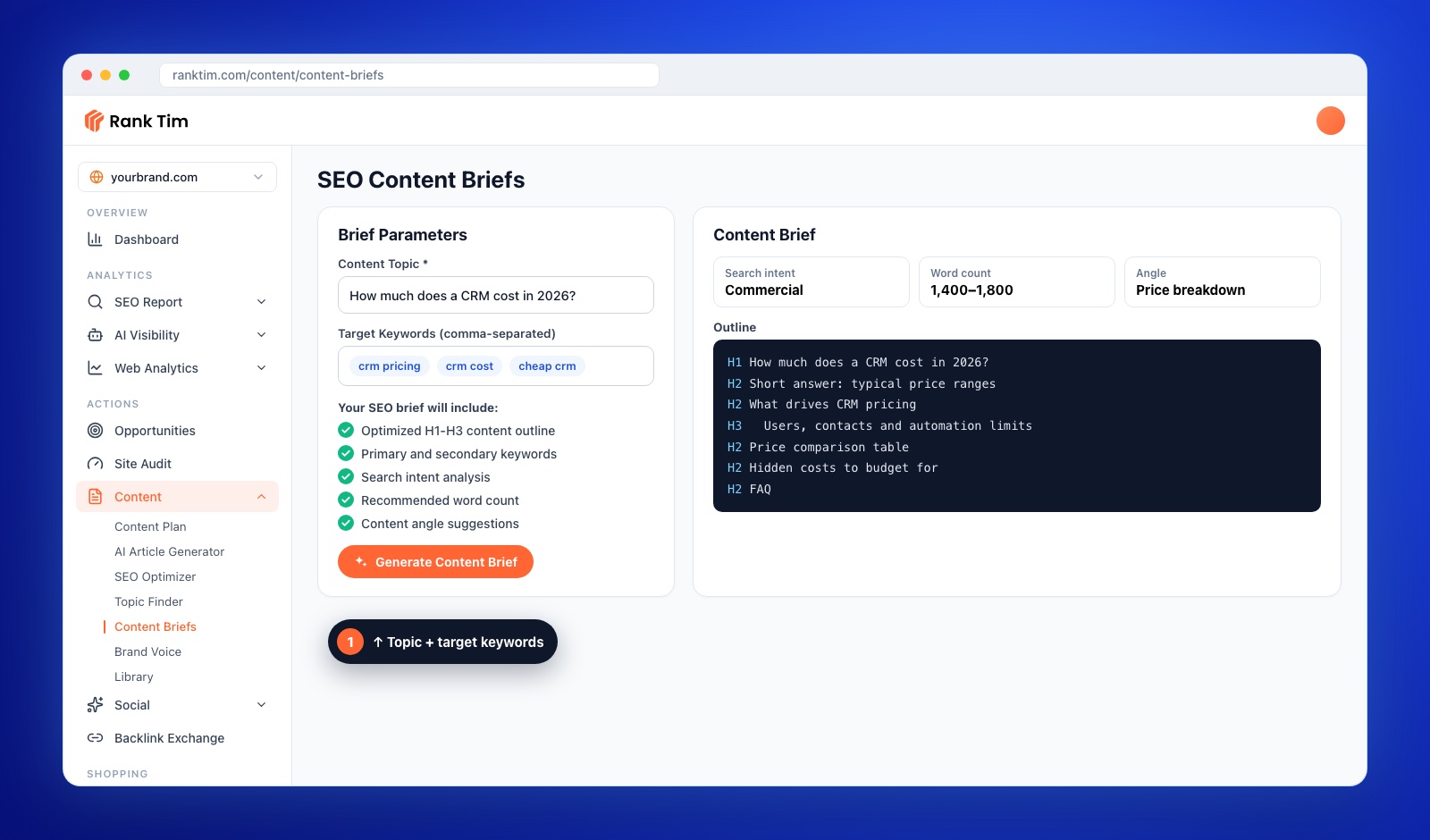
In RankTim, Content Briefs generates this structure from a Content Topic and Target Keywords: an optimized H1–H3 outline, primary and secondary keywords, search intent analysis, a recommended word count and content angle suggestions. Treat it as the skeleton, then add the sections below, which need your knowledge.
Get a first draft of your brief in under a minute
RankTim's Content Briefs turn a topic and target keywords into an H1–H3 outline, primary and secondary keywords, search intent, a recommended word count and content angles. You add the expertise.
Start Your Free TrialSection 5: Proof, Sources and Expertise
This is the section most briefs skip, and the one that most separates pages that get cited from pages that don't. List:
- Data to include, with sources: "Cite the vendor pricing pages as of October 2026; include our own average customer cost from the 2026 survey."
- Examples and screenshots: real ones, from your product or customers.
- Expert input: who should review the piece or provide a quote, and on what.
- Claims to avoid: anything you can't back up.
AI assistants and search engines both favour pages that are specific and verifiable. A brief that asks for proof gets a page that has it.
Section 6: Internal Links, Schema and Call to Action
- Links in: which existing pages should link to this one once it's live.
- Links out: the pillar page and 2 or 3 related pages this one should link to. Our topic clusters tutorial explains how to plan them.
- Schema: Article or BlogPosting with a real author; FAQPage if there's a visible FAQ; Product or HowTo where it fits.
- Call to action: one primary next step for the reader.
Section 7: Length, Format and Definition of Done
Give a word count range based on what ranks and what the topic needs, not an arbitrary target. Then define "done":
- The direct answer is in the first paragraph.
- Every question in Section 2 is answered.
- Every statistic has a source and a date.
- The page has the required internal links and schema.
- The title and meta description are written.
The Copy-Ready Content Brief Template
| Field | What to write |
|---|---|
| Working title | Includes the primary keyword, promises a clear outcome |
| Goal | What this page should achieve for the business |
| Reader | Who they are, what they know, what they need |
| Search intent | Informational, commercial, transactional or navigational, checked against current results |
| Primary / secondary keywords | One primary, 3 to 8 secondary |
| Questions to answer | From PAA, Search Console, sales and AI prompts |
| Direct answer | The 1 to 2 sentences the page opens with |
| Outline | H2/H3 headings with the format of each section |
| Proof and sources | Data, examples, screenshots, expert input, claims to avoid |
| Internal links | Pages linking in, pages to link out to, pillar page |
| Schema and CTA | Structured data types and the one primary call to action |
| Length and done criteria | Word count range and the checklist above |
After Publishing
A brief is also a measuring stick. Four to eight weeks after publishing, check the page against it: does it rank for the primary keyword, does it appear for the questions you listed, and is it cited in AI answers for the related prompts? If not, the gap usually points to a specific section: a missing answer, weak proof or not enough internal links. Our content refresh guide covers how to update it.
Frequently Asked Questions
How long should a content brief be?
Usually one or two pages. It should contain decisions, not research notes: the reader, the intent, the direct answer, the outline, the proof and the links.
Who should write the brief, the SEO or the writer?
Ideally the SEO or content strategist writes it and a subject-matter expert reviews it. The writer should be able to start without asking basic questions.
Can AI write content briefs?
AI tools can produce a strong first version of the outline, keywords and intent analysis in seconds. The sections that make content stand out, like proof, examples, expert input and the direct answer, still need human knowledge.
Do briefs matter for AI search?
Yes. Briefs that require a direct answer up front, clear question-based sections and verifiable data produce pages that AI assistants can understand and quote more easily.
Great content is rarely an accident. It's usually the result of a brief that made the important decisions before anyone started typing.
From Brief to Published Article, in One Place
Generate briefs, write and optimize articles, plan your calendar and publish to WordPress automatically. Then track rankings and AI citations for every page.
Start for Free
Catalin Dinca
Written by Catalin Dinca