
How AI Agents Are Reshaping Brand Visibility in 2026
 Catalin Dinca
Something significant happened to brand visibility over the last eighteen months, and most marketing teams have not fully registered it yet. The way people discover, evaluate, and decide between brands is being restructured by a technology that does not browse the way humans do, does not respond to the same persuasion signals, and does not care about your homepage headline.
AI agents — systems that can research, reason, compare, and recommend autonomously on a user's behalf — are now embedded in the research workflows of a fast-growing segment of buyers. When a procurement manager asks their AI assistant to evaluate project management platforms for a team of thirty, the agent does not wait to be marketed to. It finds what it needs, forms a judgment, and delivers a shortlist. Your brand either made it onto that list or it did not. And the decision happened without a single human reading your website.
Understanding why that happens — and what determines whether your brand is included or excluded — is the most important brand visibility question of 2026.
What Separates an AI Agent from a Standard AI Chatbot
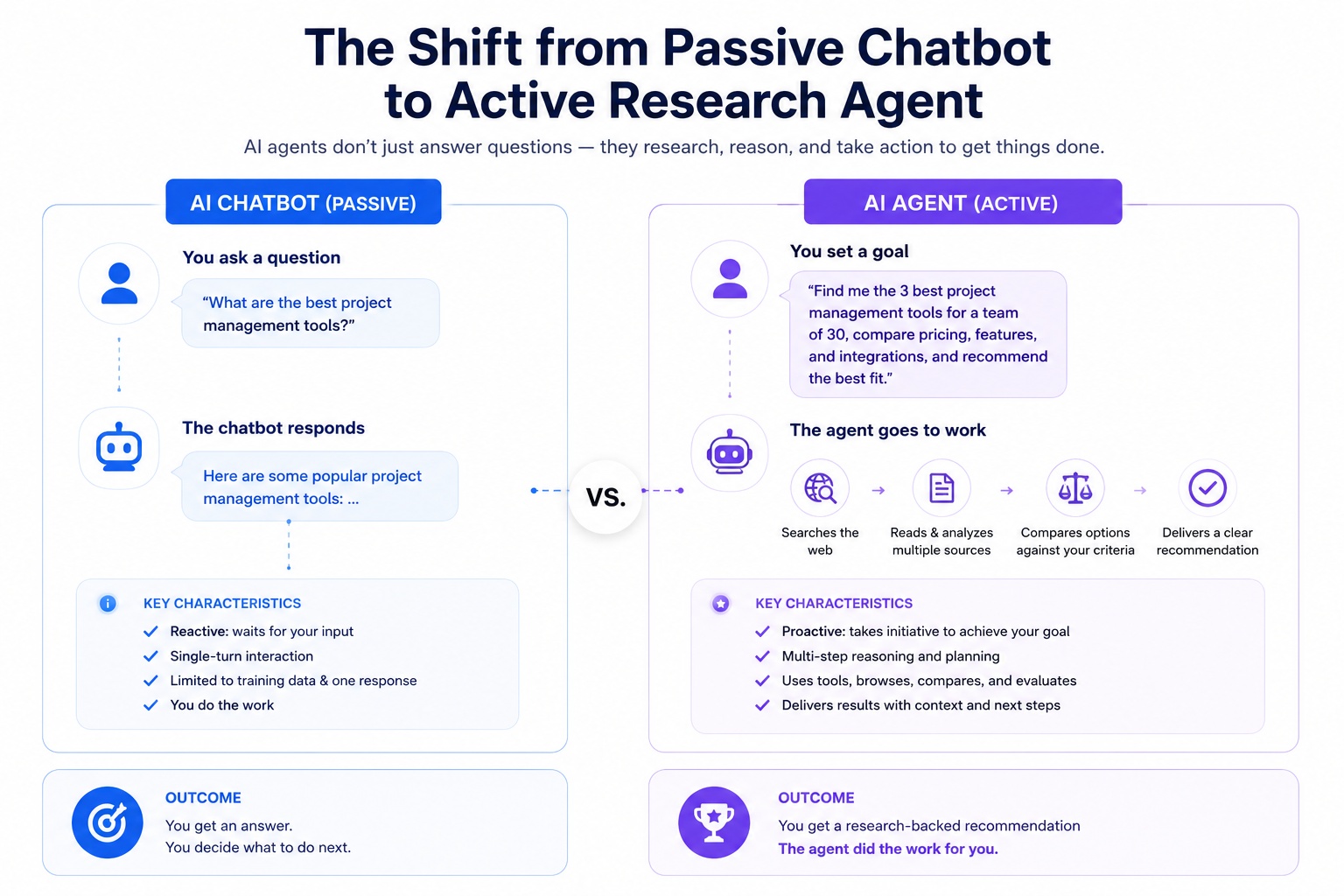
The distinction matters practically, not just technically. A standard AI chatbot responds to what you type. You ask a question, it generates an answer. The interaction is reactive and bounded by a single exchange. An AI agent, by contrast, is goal-directed. You give it an objective, and it figures out what steps are required to achieve that objective, executes those steps, evaluates the results, and iterates until the goal is met.
In practice, this means an agent can take a task like "find me the three best enterprise HR platforms under fifty thousand dollars per year, compare them on implementation time and support quality, and tell me which one fits a company that has just gone through a merger" — and actually complete it. The agent searches for relevant sources, reads vendor documentation and pricing pages, pulls in third-party review data, applies the criteria you specified, and returns a structured recommendation with reasoning.
The components that make this possible are a large language model for reasoning and language understanding, plus a set of tools — browsers, search engines, APIs, databases — that let the model interact with external information. The language model is the thinking layer. The tools are what give that thinking real-world reach. Together, they create a system that can operate with a degree of autonomy that has no real precedent in consumer technology.
The Two Modes Agents Operate In — And Why Both Matter for Brands
Agentic AI operates across a spectrum from advisory to executive, and your brand's visibility requirements differ meaningfully across that spectrum.
In advisory mode, the agent researches, analyzes, and recommends. A human sees the output and makes the final call. This mode is already operating at scale. Sales teams use it to research competitors. Procurement managers use it to evaluate vendors. Individual buyers use it to narrow down software subscriptions, financial services, and professional providers. In every one of those use cases, the agent is making editorial judgments about which brands are worth including in a recommendation and which are not worth mentioning. If your brand is not in the output, it is not because the user rejected you. It is because the agent never surfaced you in the first place.
In executive mode, the agent takes action without waiting for per-step human approval. Book a hotel. Renew a subscription. File an expense report. Schedule a service call. Users define the parameters and confirm the final outcome, but the agent handles the research, selection, and transaction steps autonomously. This mode is less common today but growing rapidly — and for brands operating in booking, subscription, or service categories, it is already the mode that matters.
The brands that handle advisory mode well are building the foundation for executive mode. If an agent has consistently found your brand credible, legible, and easy to work with during recommendation tasks, it will include you in action tasks when the time comes. The two modes are not separate problems. They are sequential phases of the same challenge.
What AI Agents Actually Look for When They Evaluate a Brand
When an AI agent encounters your digital presence during a research task, it is not experiencing your brand the way a human visitor would. It is not responding to visual design, emotional copywriting, or the flow of your landing page narrative. It is extracting specific pieces of structured information and comparing them against the criteria it was given.
The evaluation happens across two dimensions simultaneously.
The first dimension is informational legibility. Can the agent find the specific facts it needs to include you in a comparison? Is your pricing explicitly stated or hidden behind a "contact us for pricing" barrier? Are your features described in plain, specific language that maps to real user needs, or are they wrapped in brand language that requires interpretation? Is your service area, your guarantee policy, your implementation timeline, your support model — all of that findable and parseable without human interpretation? Every piece of information your agent needs to include you in a recommendation that it cannot find or cannot parse is a reason to skip you in favor of a competitor whose information is clearer.
The second dimension is cross-source credibility. An agent evaluating your brand does not stop at your own website. It reads what independent sources say about you — review platforms, industry publications, comparison sites, forum discussions, expert commentary. The aggregate picture it builds from those external sources is a significant input to whether it classifies your brand as credible and recommendable. A brand with excellent owned content but thin or conflicted external coverage is at a systematic disadvantage compared to a brand with solid external validation, even if the owned content is superior.
These two dimensions — legibility and credibility — are related to traditional SEO but distinct from it. You can rank well on a keyword while failing on legibility if your pages are optimized for human reading rather than information extraction. You can have strong backlinks while failing on credibility if those links come from sources AI systems do not treat as authoritative. The same underlying investments — clear content, genuine third-party endorsement — serve both goals, but the emphasis and execution differ.
Why Traditional Brand Visibility Metrics Do Not Capture This
Most brand visibility reporting is built around metrics that were designed for a world where humans browse search results and visit websites. Keyword rankings. Organic traffic. Click-through rates. Share of search. These metrics measure how visible your brand is to human searchers navigating a traditional search experience.
They do not measure whether your brand appears in AI agent research outputs. They do not capture whether your pricing is legible to an automated evaluation. They do not reflect whether the third-party sources AI agents prefer in your category are covering your brand or your competitor. They do not show what an AI agent concludes about your brand when it is given a research task in your category.
This creates a measurement gap that is growing as agentic AI use grows. A brand can be performing well on every traditional visibility metric while being systematically excluded from AI agent recommendations — and have no way of knowing it from the data they currently collect. The gap between what traditional analytics shows and what is actually happening in AI-mediated research workflows is one of the defining strategic blind spots for marketing teams in 2026.
Five Things Brands Need to Do Differently for Agentic Visibility
Make Every Critical Fact Machine-Readable
Go through your most important pages with a single question in mind: if a system were trying to extract the key facts about this page programmatically, could it do so reliably? Pricing, feature lists, service area, credentials, policy terms, turnaround times — every piece of information that a potential buyer would need to evaluate you should be present in plain, structured language on your owned properties. Schema markup formalizes this further by giving crawlers explicit signals about what each piece of content represents. The combination of clear copy and structured data eliminates the legibility barriers that cause agents to skip over brands that are otherwise competitive.
Audit Your External Coverage Systematically
Build a map of where your brand appears across the sources that matter for agentic evaluation in your category — review platforms, comparison sites, industry publications, analyst reports, authoritative forums. For each source, assess whether the information is accurate, whether it is competitive with how your top competitors are represented there, and whether it is the kind of source AI systems treat as credible. Gaps in this map are directional priorities for your earned media and reputation management effort.
Create Content That Answers Comparison Questions Directly
Agents frequently research by asking comparison-type questions: which platform is better for X use case, how does brand A differ from brand B on feature C. Content that directly addresses these comparisons — structured as clear, extractable answers rather than as persuasive marketing pieces — is much more likely to be cited in agentic research outputs. A well-structured comparison page that honestly describes where you are stronger and where a competitor is stronger is more useful to an agent than a page that simply claims superiority across every dimension.
Align Your Brand Description Across Every Channel
When an AI agent encounters conflicting information about your brand across different sources — different descriptions of what you do on your homepage versus your LinkedIn profile versus a third-party directory listing — it builds a less confident picture of who you are. That lower confidence translates directly into lower citation frequency. Audit your owned and major third-party channels for consistency in how your brand, product, and value proposition are described, and bring them into alignment.
Track What AI Systems Are Actually Saying About You
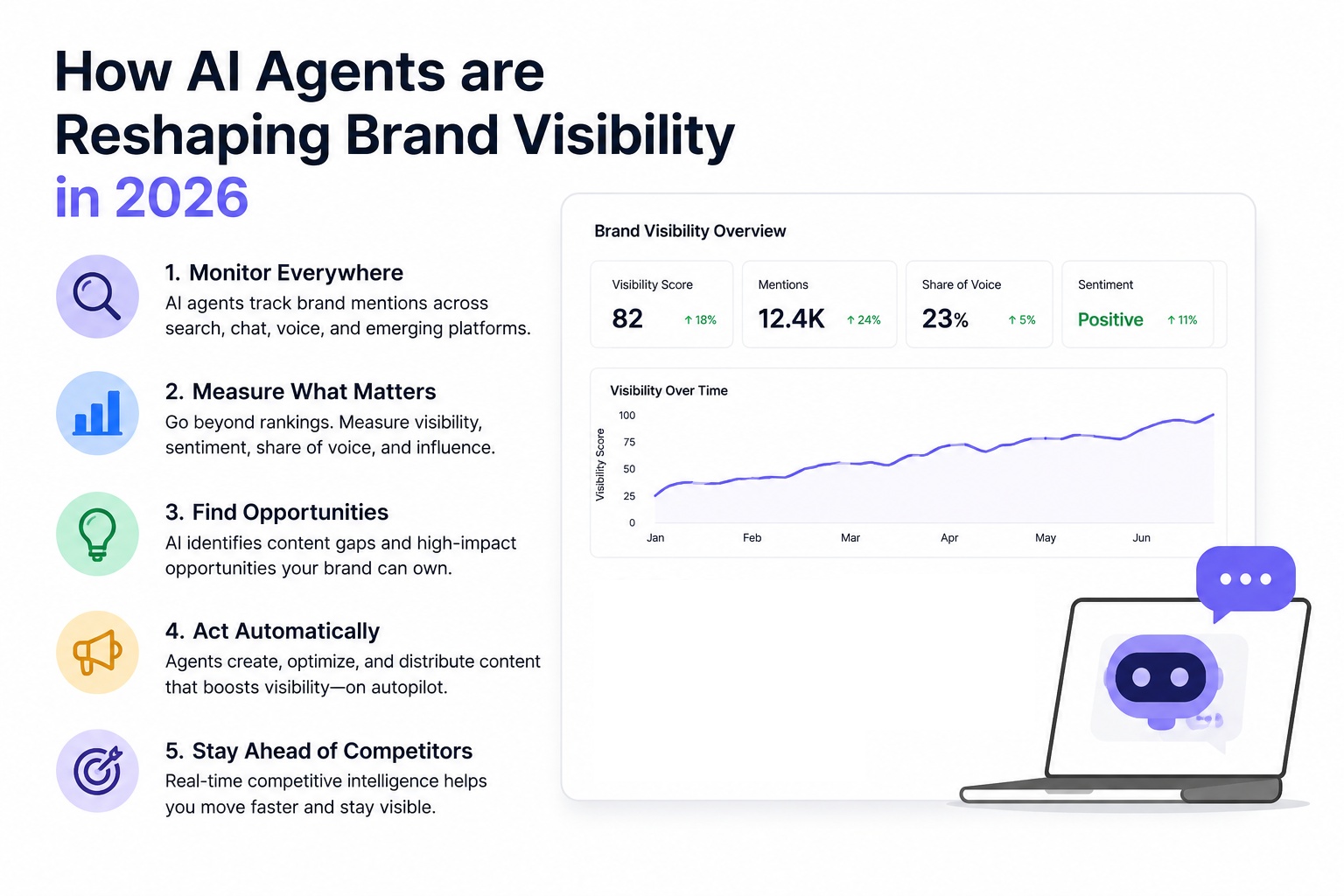
None of the above improvements are measurable without a system that tells you what AI agents currently know, say, and recommend about your brand. Manual checks are unreliable because agent responses vary between sessions. You need automated tracking across the AI platforms your audience uses, running on a regular cadence, capturing mention rate, competitive position, sentiment, and citation sources.
How RankTim Closes the Measurement Gap
RankTim is built specifically to provide the visibility layer that traditional analytics cannot. While your GA4 dashboard shows what happened after a visitor arrived, RankTim shows what AI systems are saying about your brand before a user ever visits — in the research and recommendation phase where agentic evaluation happens.
The AI Visibility dashboard shows how often your brand appears in AI-generated responses across ChatGPT, Perplexity, Gemini, and Google AI Mode for the queries that matter most in your category. You can see your mention rate, your competitive position within responses, the sentiment surrounding your brand mentions, and whether those mentions include a link back to your site.
The Source Attribution feature reveals which third-party sources AI platforms are drawing from when they discuss your category. This is directly actionable for your earned media strategy — if AI agents consistently cite a particular review platform or industry publication when discussing your competitors, those become your highest-priority coverage targets.
SEE HOW AI AGENTS EVALUATE YOUR BRAND TODAY
with the RankTim AI Visibility Toolkit
Start Tracking FreeThe Competitor Intelligence dashboard shows you which brands are being recommended for the prompts where your brand is absent. That gap analysis is where most brands find their most immediately actionable insights — not a generic observation that AI visibility matters, but a specific list of queries where a named competitor is appearing and you are not, with the information you need to understand why.
Together, these features give you the baseline measurement and the ongoing tracking that turns AI agent visibility from an abstract concern into a managed program with clear metrics, clear targets, and clear progress.
The Compounding Advantage of Investing Early
AI agent adoption is not evenly distributed across buyer populations, but it is growing consistently across almost every category. The brands that build agentic visibility now are not just winning today's agent-mediated research sessions. They are building the citation history, external coverage, and structured information clarity that compounds over time.
When an AI agent has encountered a brand consistently across multiple research tasks and found it credible, legible, and well-supported by external sources, that brand develops a kind of trust momentum with AI systems that is increasingly hard for late movers to close. The barrier is not technological — it is the accumulated depth of genuine credibility signals that take time to build regardless of how much budget you direct toward the problem later.
The brands treating AI agent visibility as a strategic priority today are building that momentum. The brands waiting for clearer signals are watching the gap grow.
AI Agents and Brand Visibility FAQs
What is an AI agent and how is it different from a regular AI chatbot?
A regular AI chatbot responds to single prompts — you ask, it answers. An AI agent is goal-directed: you give it a task, and it plans and executes the steps needed to complete that task, including browsing external sources, comparing options, and iterating on its approach. Agents make independent research and recommendation judgments that a basic chatbot does not.
Why does AI agent visibility matter more than traditional search rankings?
In traditional search, your page appears in results and a human decides whether to click. With AI agents, the agent makes editorial decisions about which brands to include in its recommendation before the human ever sees the output. If you are excluded from the agent's shortlist, no click is possible. The decision happens at a layer that traditional SEO metrics do not capture.
What determines whether an AI agent recommends my brand?
Two things primarily. First, informational legibility — whether your pricing, features, credentials, and policies are clearly stated and machine-readable on your owned properties. Second, cross-source credibility — whether independent review platforms, publications, and comparison sites describe your brand positively and consistently. Agents weight both when forming recommendations.
Can small brands appear in AI agent recommendations against larger competitors?
Yes, and the mechanism is similar to why smaller brands can sometimes outperform larger ones in AI search visibility generally. Agents favor clarity and specificity over domain size. A smaller brand with precise, well-structured information and genuine independent coverage in the right niche sources can consistently appear in recommendations alongside larger competitors that have broader but less focused digital presences.
How do I know what AI agents are currently saying about my brand?
Manual checks are unreliable because agent responses vary between sessions. Automated tracking across the AI platforms your audience uses — running consistent prompt sets on a regular schedule and recording mention rate, position, sentiment, and source attribution — is the only reliable way to know what agents are currently saying about your brand. RankTim provides this tracking infrastructure specifically for AI platform visibility monitoring.
How quickly can AI agent visibility improve after making optimization changes?
Content changes that improve informational legibility — restructuring pages to make facts more extractable, implementing schema markup, clarifying pricing and feature descriptions — can produce measurable improvements in AI citation frequency within four to eight weeks. External coverage changes take longer because they depend on publication cycles and how quickly AI platforms index new content. A consistent program combining both approaches typically shows clear improvement over a one to two quarter timeframe.

Catalin Dinca
Written by Catalin Dinca